Showing posts with label january. Show all posts

Thursday, 30 January 2014

(31) January 31: Exodus 24-26 & Matthew 21:1-22

Ask God to open your mind, heart and will to understand, delight in and obey what you read.


To discover:­­
As you read consider what the details of the Tabernacle instructions convey.

To ponder:
In chapter 24 the Mosaic Covenant is formally confirmed. Moses relates the “words” (ch 20) and “laws” (chs 21-23) to the people. They agree to do “everything” and Moses writes it all down in the “book of the covenant” (24v4, 7). Burnt offerings atoned for sin. In them the dead animal is a substitute for the sinful people: Its blood symbolises its life given. Fellowship offerings then expressed the peace with God that resulted. By offering these on an altar of twelve pillars corresponding to the tribes, we see God can only enter into a covenant with sinful Israel (or us) if his anger is appeased. In this context, the book was read and the people reaffirmed their agreement.
As God instructed (24v1), Aaron and sons (later priests), and 70 representatives are allowed part way up the mountain. And they “see,” eat and drink with God! That’s the fellowship he has with his people. The pure, heavenly and expansive nature of his rule is implied by the pavement of sapphire beneath him. It’s not however clear what shape he had; but we may wonder if this was the pre-existent Christ.
Moses is called higher to be given the Ten Commandments on tablets of stone. Alluding to Genesis 1, the cloud settled on the mountain for six days, suggesting the law is for the people to act like a new humanity in a new creation. As “a consuming fire” God’s glory reminded Israel of his burning holiness against sin (Heb 12v28-29). Only after this period is Moses called into the cloud. The number 40 denotes a period of testing (as in the desert) and blessing (the reign of good kings). Moses 40 days (v18) would end in receiving the blessing of the law. But it was also a time in which Israel’s obedience was being tested in the absence of her leader.
Jesus draws on this event at the last supper. His new covenant is confirmed with his blood, which atones for our sin so we can enjoy fellowship with God. And as his disciples ate and drank with him (as we do), they looked towards the day when we will eat and drink in his kingdom (Lk 22v20-30), a new humanity in a new creation.
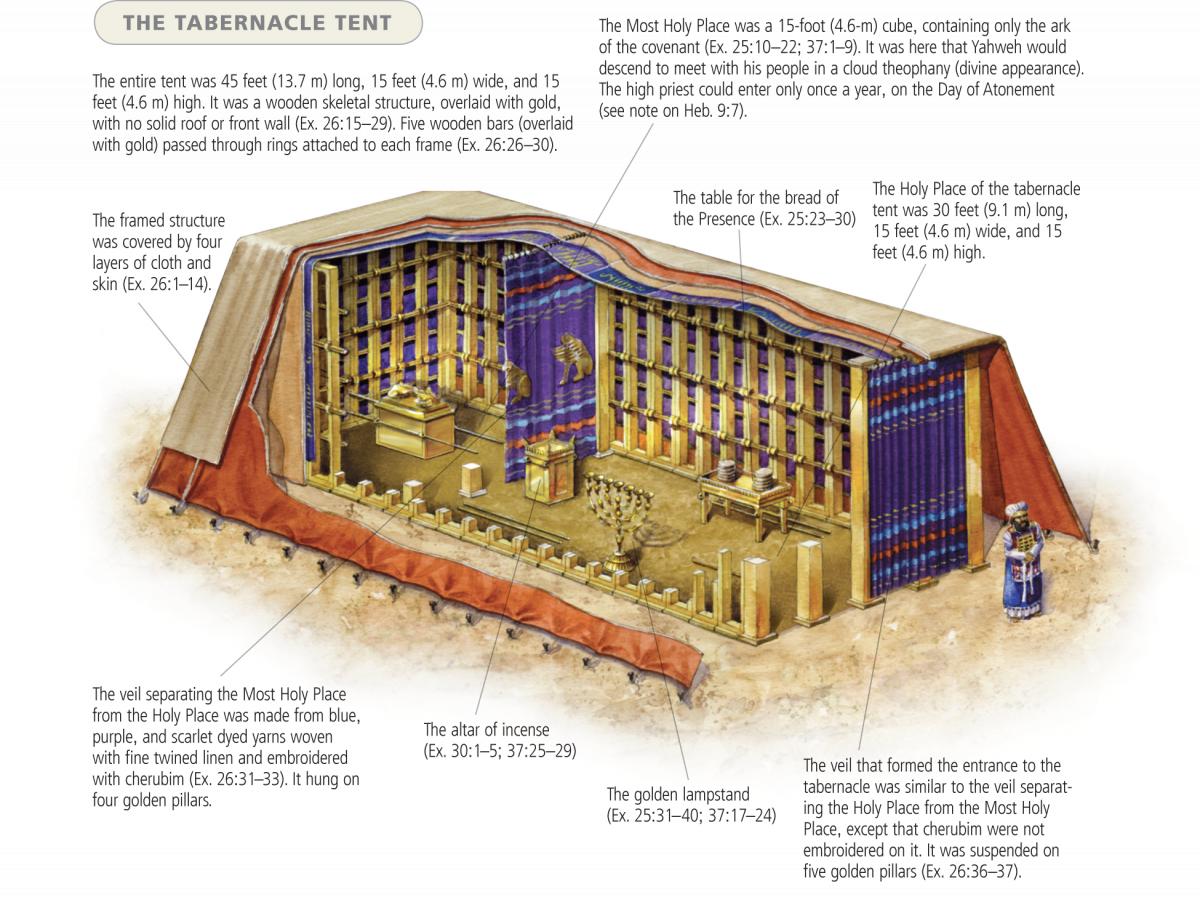
            With the covenant relationship formalized, the construction of the tabernacle stresses God’s presence now with Israel (25v8). The “bread of the Presence” (v30) reminded them this meant ongoing provision. However, by separating off the Most Holy Place, Israel were taught they couldn’t actually survive close fellowship (26v33-35). Christ needed to achieve access (Mk 15v38).
Central is the ark within which the “testimony” (the Ten Commandments) were placed. It’s cover is where atonement is to be made for breaking those commandments (v17). But it also acts like a throne for Israel’s invisible God, as it is there that God would give Moses further commands (24v22).
By repeating all is to be “according to the pattern” given on the mountain, the tabernacle is portrayed as a scale model of heaven where God dwells. Hebrews explicitly states this (Heb 9v11, 23-24). The materials stress just how special and heavenly it is. Eden was a place of gold and onyx, and guarded by cherubim (Gen 2v11-12, 3v24). So the tabernacle is a little Eden within the wider world. Nevertheless, it is only constructed by each man giving “as his heart prompted him” (25v2). Likewise, we give to see the church built as the place of God’s special presence in the world now (Eph 2v22). Shouldn’t it also be a taste of paradise?

Praying it home:
Praise God for his willingness to fellowship with us. Pray that we would be generous in giving to the building of his church.

Thinking further:
For more on the Tabernacle see here. To see a picture of the tabernacle, click here.

If you receive this post by email, visit bible2014.blogspot.co.uk and make a comment.

Wednesday, 29 January 2014

(30) January 30: Exodus 22-23 & Matthew 20:17-34

Ask God to open your mind, heart and will to understand, delight in and obey what you read.


To discover:­­
As you read note the different sections to these laws.

To ponder:
In 22v1-15 restitution is greater than the loss, acting as a deterrent too. Protections are also made against taking advantage of the law. People cannot use the protection afforded if a thief is killed at night as an excuse for simple murder. Judges are also introduced to weigh cases. Missing property can’t just be blamed on a thief. Guilt must be established (22v8, 11). Paul urges believers to judge disputes within the church (1 Cor 6v1-6).
            22v16-17 presumes sex was to be within marriage. Indeed, sex outside marriage is effectively a commitment to marry, as the two become one flesh (Gen 2v23-24). Nevertheless, the girl is protected. Dad can intervene. How trivialised pre-marital sex has become today.
            Sorcery is somewhat trivialised today too. But here it is treated severely (22v18) no doubt because it dabbles with the demonic and leads people from reliance on God.
            God’s concern for the outcast and needy is a dominant theme. As Christians, Israel’s history is ours too. So we should share this concern for immigrants, especially those treated badly – or trafficked (22v21, 23v9). And consider the strength of condemnation (22v22-24) if Israel do not care for those who have no-one to care for them. Should we add the elderly and unborn today? The poor are also to be cared for, being lent money without interest, never brought to the point of having nothing (22v25-27), and given every seventh year to benefit from the land (23v11). The point is that God “hears the cry” of the needy, and feels compassion for them (22v23, 27).
            God’s care even for animals is apparent: The firstborn who are his, are to be with their mothers for seven days (22v30). Animals are to benefit from the Sabbath year and day (23v11-12). 23v19 may even teach goats are not to be offered whilst still taking their mother’s milk. It is often forgotten that Christians in the past led campaigns against cruelty to animals.
            God’s concern for justice is also evident (23v1-7). Testimony must be trustworthy, impartial and unbribable. The poor are neither to be shown favouritism nor denied justice (23v1-7). And looking to Christ’s own teaching, enemies should not be discriminated against in care (23v4-5).
            22v28-31 reaffirm devotion and generosity to God. v31 probably stresses that as God’s special people Israel are to eat only the best. Three key festivals are affirmed, when the men are to assemble before God: First, Unleavened Bread, when the Passover would be celebrated. Its stipulations are reiterated (23v18). Second, Harvest (later, the Feast of Weeks, or Pentecost), when the first of the crops would be presented to God (23v16, 19). Third, Ingathering (later, the Feast of Booths), when the last of the harvest would be presented. By these means God’s redemption and provision are to be remembered with thanks.
            Having outlined the covenant’s requirements, God’s promise of an angel to guard and speak to Israel places her in continuity with the Patriarchs (Gen 48v16, 15v12-18). His promise to them will be fulfilled if Israel remain faithful, listening to him and not turning to the gods or practices of the nations around them. However, everything will be according to his wise timing (23v20-32).

Praying it home:
Praise God for his concern for justice and the needy displayed in his law. Pray that we would reflect those same concerns in practical ways.

Thinking further:
Paul points out three uses to God’s law: First, it supervised Israel by restraining sin (Gal 3v23-25). In doing so, if carefully applied, its principles may be helpful in restraining sin in wider society too. Second, it was to lead Israel to Christ by showing how sinful and in need of being justified they were (Gal 3v24). As we read it, we should therefore be convicted of our sin and become all the more thankful for God’s grace in Christ. Third, it remains a guide to Christian life in the Spirit (Rom 8v1-8, 13v8-10). As mentioned yesterday, we therefore seek to apply it to our context after Christ. Strikingly, Jesus taught the law accommodated the hard hearts of Israelites (Matt 19v8). So a greater righteousness is required of the Christian displayed no longer in forced outer obedience to rigid regulations, but a Spirit-given inner obedience to the principles reflected in them (Matt 5v17-30). Paul can therefore say that as a Christian he is not “under the law,” because he is not required to obey its outer requirements as a system. The era of the Mosaic covenant has passed. Nevertheless Paul is “not free from God’s law” but “under Christ’s law” (1 Cor 9v20-21). This probably means that God’s underlying requirements that reflect his character and the order of creation remain, and are summed up in Christ’s command to love.

If you receive this post by email, visit bible2014.blogspot.co.uk and make a comment.

Tuesday, 28 January 2014

(29) January 29: Exodus 19-21 & Matthew 20:1-16

Ask God to open your mind, heart and will to understand, delight in and obey what you read.


To discover:­­
As you read note how God’s holiness is displayed.

To ponder:
Fifty days after the Exodus, God establishes what’s termed the “Mosaic covenant.” The nation will spend a year at Sinai. Moses is the go-between (mediator). He relates God’s words. God reminds Israel of his grace and care for them (19v4). His covenant promise? They will be especially his: cherished and precious like treasure, and set-apart for his service (holy) like priests - perhaps hinting at their role of instructing the world in God’s ways. God’s covenant proviso? They must “fully” obey and so “keep” the covenant. The elders and people enter the covenant by their commitment to obey (9v7-8). Wonderfully these terms are used of us in our calling to “declare God’s excellencies” to the world (1 Pet 2v9-12).
            The obedience required is summed up in covenant “words” (20v1-17) to be written on stone. This is followed by “laws” (21v1-23v19), comprising “the book of the covenant” (24v3-4,7). To ensure Israel rightly fear, trust and obey however, God first displays his holiness (19v9, 16, 20): Three days of safeguards (abstaining from sex may have stressed devotion to the LORD) are followed by the climax of God’s awesome presence descending to “meet” with the people.
            In this context Moses leads the people to the mountain. God calls Moses up and reiterates the need to keep the people back. Moses then descends, and God speaks audibly to the people (20v1, Deut 4v19-13). They are so terrified they beg Moses to relay God’s word from that point (20v19). There could be no more powerful way to stress the weight with which we should treat God’s word. We are even more responsible (read Heb 12v18-29).
            The Ten Commandments are singled out, summing God’s will. Again, obedience is a response to grace received (10v2, 19v4-5). Like a loving husband, God is jealous, wanting Israel’s faithfulness. He warns that their personal response will implicate subsequent generations (20v5-6). They are not to call on God’s name flippantly, treating him at their beck and call (20v7). Especially, they are to devote a day of rest to remembering him. The call to honour parents has a prominent position. God’s purposes were to be fulfilled through offspring and parents were to pass on the faith. So honouring them was a key indicator of Israel’s faithfulness to God and whether they would therefore remain in the land (Eph 6v1-4).
            Following the commandments, the importance of simple and pure worship is stressed (20v22-26) – even though it would become elaborate. Dressed stones were used by pagans and nakedness after the fall was a sign of shame. God looks for uniquely Christian and modest worship from us also (1 Tim 2v9-10).
            Hebrews might be sold into servitude to pay debts or protect against poverty. In 21v2-11 God’s law ensured the rights of male servants to eventual freedom and to remain with their families. Female servants married to their masters were protected against being discarded or deprived – a word for relationships today.
           The laws in 21v12-36 stress retribution – punishment must match the crime (21v23-25); restitution – loss must be compensated; and responsibility – intent or negligence makes actions more serious. The death penalty applies Genesis 9v5-6. 21v15 and 17 are addressed to adults with respect to their parents, referring to attempted murder and contemptuous speech. They reflect the critical importance of the family mentioned above.
           
Praying it home:
Praise God for the wisdom and goodness of his commands throughout scripture. Pray that we would hear his word with due reverence and awe.

Thinking further:
For space we will not be able to comment on all laws. Two things need being said however. First, God’s law is given to a specific context. Israel are not in a position to manage prisons where life sentences may be served, nor to deal with complex legislation printed in numerous volumes of books. Rather they are a primitive society that have to survive in the desert and in Canaan against all the odds if God’s purposes are to be fulfilled. Critical to this is the cohesion of society and the family. Certain laws may seem too permissive like the legislation for slavery, or too harsh like the death penalties. But we must trust God’s wisdom in knowing what was necessary for Israel then, recognising our inability to judge these things from this distance and our own culture. Second, for these reasons we cannot just apply the law directly to our context. What it reflects are the principles of God’s character and creation applied to Israel’s circumstances (20v11, 1 Pet 1v14-16). As those made in God’s image, these principles were originally imbedded in human beings, and they are now written on the Christian’s heart by the Spirit (Heb 8v10, Eph 4v24). Our need is therefore to consider what these principles are, and any parallel circumstances they can and should be applied to today. This is somewhat easier where the New Testament does this for us.

If you receive this post by email, visit bible2014.blogspot.co.uk and make a comment.

Monday, 27 January 2014

(28) January 28: Exodus 16-18 & Matthew 19:16-30

Ask God to open your mind, heart and will to understand, delight in and obey what you read.


To discover:­­
As you read consider how God is preparing Israel to receive his law.

To ponder:
Moses’ faith is commended for preferring mistreatment with God’s people to “the pleasures of sin” and “treasures of Egypt” (Heb 11v24-27). But just a month after the Exodus, “grumbling” and pining for the food of Egypt marks out Israel. Despite witnessing God’s powerful provision, they
display disgruntled unbelief. So do we? Our call is to do “everything without complaining or arguing” (Phil 2v14).                              
            God’s promise of “raining down bread from heaven,” and even providing meat is astonishing (16v4, 11). With immense patience, he is again going to show it was he who redeemed Israel. But his instructions about gathering will test their readiness to obey.
            God displays his glory in the cloud (perhaps as in 19v16). This affirms who is about to provide. And yes, he gives in abundance (16v13-15) - the manna for their entire 40 years in the desert. An omer is to be stored in the ark of the covenant when built, to remember this (16v31-35). Generally Israel collected as told (16v17). But some didn’t, angering Moses and God (v20, 28). The instructions, especially regarding the Sabbath teach the people how important obeying God’s law and remembering God and his acts on the Sabbath will be (v28).
            Jesus is the bread that will sustain us until we are raised to enjoy our “land.” His instruction is for utter commitment described as “feeding” on him. Like Israel, many find this instruction too much and disobey it (Jn 6v3-35, 53-70).
            Israel haven’t learnt their lesson (17v1-2). Now they “test God,” wanting him again to prove he is “among” them (17v7). Once more, in grace, God patiently provides, stressing his presence: “I will stand there before you by the rock.” They are now at “Horeb” – the vicinity of Mount Sinai (3v1). Importantly, God had said the sign of his presence with Moses was that he would eventually bring the people here (3v1, 12).
            Paul writes that Israel were “baptized” into Moses in the cloud and sea. With the manna and water in mind, he even says they “ate the same spiritual food” and “drank the same spiritual drink” as we do in communion (10v1-4, 14f). His point seems to be that God’s presence was Christ’s presence. So, whether one of faith or not, the people’s response to God through these events was actually a response to Christ!
            Like Melchizedek, Jethro is an upright Gentile. As God intended in the Exodus, he “hears” of what God did and honours him. But Moses plays his part as witness too (18v8). Jethro’s delight, praise, confession of God’s supremacy, offering of sacrifices and fellowship with God and the elders surely displays true faith (and importance). It looks to the inclusion of Gentiles through the witness of us as God’s people.
            Moses had previously sent his wife and sons to Jethro (probably to protect them). The repetition of the sons names remind us that Israel are now aliens yet saved by God (18v3-4). And they need government in order to receive God’s law and become a kingdom. This comes not by command from God but wisdom given Jethro: Moses is to teach the law and the people bring their harder disputes to him. However he must delegate for lesser cases, appointing judges over fifties, hundreds and thousands. This would become the pattern for elders in Israel and then in the church (Tit 1v7-9). They are not just to teach but be consulted for wisdom.

Praying it home:
Praise God for spiritually sustaining us in Christ, and especially as we look to him at the Lord’s Supper. Pray for your minister to be faithful and wise in his teaching and counsel.

Thinking further:
The desert of “Sin” has nothing to do with “sin” as disobedience. Quail migrate over the desert. God’s provision for Israel may have been through them falling through exhaustion at exactly the time Israel needed them. The miraculous nature of the manna is seen in it always being just the right amount. In fact, it is bread-like and sweet, yet melts away in the sun (16v21). Moreover, it only keeps for an extra day on the Sabbath, but can still be stored long term as a reminder in the ark of the covenant when it is built (16v32-34).

If you receive this post by email, visit bible2014.blogspot.co.uk and make a comment.

Sunday, 26 January 2014

(27) January 27: Exodus 13-15 & Matthew 19:1-15

Ask God to open your mind, heart and will to understand, delight in and obey what you read.


To discover:­­
As you read consider what God is to be praised for.

To ponder:
With confidence that God would bring Israel to the land, she is urged to commemorate these events – and again, teach the coming generation (13v8). Importantly, this is the reason for the people to speak of and observe God’s law. Their obedience is a response to his grace, not a means of earning it. We too obey “in view of God’s mercy” (Rom 12v1).
            Israel’s firstborn sons (and animals) have not simply been saved – but redeemed. So they belong to God (13v1). To mark this, firstborn animals have to be sacrificed to the LORD – although a substitute should be made for donkeys (perhaps all unclean animals). Sons are to be bought back (redeemed) with money (Num 18:16). This would cause them to ask “why” and so hear of God’s mighty acts (13v11-16). Through Christ, we now belong to God in a special sense, and so are devoted to his service (Rev 5v9-10).
            Though armed, the Israelites are not yet ready for battle. So God leads them away from the Philistines. Whether by pillar of fire or cloud, he never leaves them (13v22). However he has more glory to gain for himself (14v4, 17, 18). By placing the people in a vulnerable position, he draws Pharoah out. The might of the Egyptian army is stressed (14v6-7). But after all God had done, Israel should have trusted him. Instead they are terrified and grumble. They want to return to slavery (14v10-12). As we face our great enemies - the world, the flesh and the devil, we may consider returning to slavery, thinking this an easier life. Moses displays his leadership by getting them to “stand firm,” just as Christ does through his ministers.
            A key point is that “the LORD will fight” for them (14v13-14, 25). His presence in the two pillars moved between Israel and the Egyptians. He sent a wind to part the sea, confused the opposing army, and brought the waters back down to drown them. The people therefore “feared the LORD and put their trust in him and in Moses” (14v31). It is meditating on God’s great acts in Christ that should renew our fear of God and trust in his saviour.
            The parting of the waters recalls creation (1v9) and the drowning the flood. Again this portrays the Exodus as God bringing about a new humanity for a new start in a new Eden – a pattern of the reality we are part of.
            The songs of Moses and Miriam retell the events in prophetic and poetic (so not so literal) language. Throughout God is the warrior. He hurls the riders into the sea just as Pharoah hurled the Egyptian children into the Nile. The poem ends anticipating the glory he then receives as the nations hear and tremble, and with confidence that he will establish his people in the land.
            After all that, it is tragic (but human) to see the people grumble again. God mercifully turns the bitter water sweet. It’s another lesson. He did this when Moses obeyed his instructions. So Israel must “listen carefully” to his voice and “obey his commands” if she is not to suffer the plagues of Egypt (15v22-27). They are being prepared to receive the law.

Praying it home:
Praise God that he fights for us. Pray through the armour of God in Ephesians 6, so that you stand firm in God’s truth and obey him in godliness.

Thinking further:
The location of the Red Sea is uncertain. In Hebrew it is the sea of reeds. However it was substantial. In 1 Kings 9v26 Solomon could have his ships there. This miracle may have been done by wind, but it was a mighty act with a large body of water sufficient to drown an army. To see things on a map, click here.

If you receive this post by email, visit bible2014.blogspot.co.uk and make a comment.

Saturday, 25 January 2014

(26) January 26: Exodus 11-12 & Matthew 18:21-35

Ask God to open your mind, heart and will to understand, delight in and obey what you read.


To discover:­­
As you read consider why each detail of the Passover was necessary.

To ponder:

The most important event in the Old Testament; so a longer post! Again, all is done to God’s instruction and as predicted. Once more he hardens Pharoah so that he can “multiply” his wonders (11v9). The result is terrible: “worse” than ever was or will be (11v6). This is the seriousness of God’s judgement – here, on Egypt for enslaving Israel and killing Israel’s sons (Gen 15v14), and on Egypt’s gods, including Pharoah (12v12).
           In sending “the destroyer” (angel, Ps 78v49) it was “the LORD” going through the land, and “not permitting” him to enter the marked houses (12v23). The idea of judgement passing over shows that Israel warranted destruction too, but were saved through faith (Heb 11v28).
            Dating Israel’s year from the event (12v2) showed it to be a new start and the birth of the nation. It reminds us salvation comes through judgement. Heaven would not be heaven if those who reject Christ were brought into it.
            Taking the lamb four days before the Passover might be to remind Israel of the three days of darkness that preceded it (12v 3, 6, 10v21ff), or just to build anticipation. The amount of lamb was to fit the amount of people, perhaps signalling the specific nature of the deliverance to each individual (12v4). Lambs were to be without defect, with their bones not broken (12v46) – stressing God’s holiness; and slaughtered at the end of the day - perhaps stressing the day of hope just coming. The blood on the doorposts marked Israel out, and showed the lamb died in the place of the Israelites’. In being eaten and burned, the people’s absolute reliance on it may have been highlighted, or the absolute nature of the death it saved them from. The bitter herbs came to remind Israel of their bitter slavery.
            A week long “festival of unleavened bread” was to commemorate the event, with the Passover meal on the first day. Instructions are included. To ensure Israel (and especially children, 12v27) remember the event and so the LORD, those failing to celebrate were to be “cut off.” Eating bread without yeast recalled the fact that God’s deliverance was so swift that the Israelites didn’t have time to prepare their dough (12v39). The whole nation were to celebrate Passover, and foreigners only if their household were circumcised. So it was a reminder of God’s covenant faithfulness, and the call to faith.
            A wonder is that Pharoah ends up requesting blessing (12v32), and the LORD moved the Egyptians to favour and so give Israel “whatever they asked for” (12v36). Moreover, many Egyptians accompanied them (12v38), no doubt having come to revere the LORD. And consider this now great nation: 600,000 men, so probably 2 million people plus livestock  (12v37).

            Within Genesis more broadly, the Passover speaks of God’s ability to save people from death – the result of the fall. Gloriously, we see he shaped it to pattern his ultimate work in Christ. Jesus is the “lamb of God,” our “Passover lamb” without defect, whose “bones are not broken,” and who dies at Passover so God’s judgement passes over those who look to Jesus’ blood in faith (Jn 12v28, 19v31-36, 1 Cor 5v7-8, 1 Pet 1v19-20, Rev 5v12). In the Lord’s Supper we commemorate this by consuming bread and wine as tokens of his sacrifice. As with Israel, our only fitting response is to bow down and worship (12v27). We cry “worthy is the lamb who was slain,” because Christ has “purchased” and so redeemed us for God, and made us a kingdom. We gladly therefore devote all that we are and have to him (Rev 5v9-12).


Praying it home:
Thank God for his redemption worked through Christ. Pray that you would live mindful of this each day, laying your all before Christ in worship.

Thinking further:


Some think Thutmose IV was the next Pharoah. In one of his inscriptions he states he was Pharoah only because his elder brother had died early. The 430 years in Egypt echoes the more general 400 God revealed to Abraham (Gen 15v13). It is significant later: Apparently 430 years is the period from the Judges until the ark reaches Jerusalem, and the length of David’s line until exile. Adding them gives 1,290 - the number of days God told Daniel there would be before the new temple is built. We’ll have to wait until we reach Daniel to consider the significance of that!

If you receive this post by email, visit bible2014.blogspot.co.uk and make a comment.

Friday, 24 January 2014

(25) January 25: Exodus 9-10 & Matthew 18:1-20

Ask God to open your mind, heart and will to understand, delight in and obey what you read.


To discover:­­
As you read note God’s purposes in what he is doing.

To ponder:
Much is similar to yesterday: God’s power over the elements – here sending hail and storm; his exact control – “not one” Israelite animal dying. From plague 4 God’s presence in Egypt is stressed (8v22). His control and commitment to Israel there is such that he exempts Goshen where his people live. Likewise, when Christ returns he will separate the sheep from the goats (Matt 25v31-46). Plagues 7-9 are set-apart by their severity. Consider the ominous darkness “that can be felt” (10v21). Nothing like this has been seen before (9v18, 24, 10v6). Nevertheless, mercy is shown as warning is given so that people can escape (9v19). Likewise with the judgement to come.
Pharoah’s hardness becomes increasingly severe too. His officials urge him to give in (10v7), but whenever he is close to doing so, he refuses to yield. We see throughout the sinful desire to acknowledge God to an extent, but on our own terms. Pharoah even accepts he has sinned (9v27) and seeks forgiveness (10v17), but still seeks to water down God’s commands (10v11, 24). This is a false and futile faith. God, not man, is Lord. We are not at liberty to barter over his will.
The reason for Pharoah’s stubbornness is repeated: God is hardening his heart so that more plagues come - to demonstrate his “power” so that his “name might be proclaimed in all the earth” (9v16), and people might “know that the earth is the LORD’s” (9v29). God’s concern is not just for Egypt, but for the whole world who would look to Egypt as the centre of civilization. And some of Pharoah’s officials do come to fear “the word of the LORD” (9v20). They are therefore saved form the hail.
Difficult as it is, Jesus hints that God still hardens people, and against the gospel too (Matt 11v25-27, 13v10-15). Paul explicitly states this, suggesting it may be so that those who are saved come to appreciate God’s justice, power and glory all the more (Rom 9v16-24). These are hard truths that we trust God over, even though unable to fully understand (Rom 11v33-36). And we must be clear: unbelief is still a choice people have made for themselves (2 Thess 1v10-12).
            God’s purpose is also for the future generations of Israel to know he is the LORD (10v2). It’s a reminder we should eagerly tell our children and their children the matchless deeds of the Lord, seen so supremely in Christ. Much depends on it.

Praying it home:
Thank God for so mercifully warning us of the final judgement. Confess where you may have sought to water down his commands or barter over his will.

Thinking further:
Read Jim Packer on God’s Sovereignty and human responsibility here. Or read the NIV study Bible introduction to Exodus, by clicking here.

If you receive this post by email, visit bible2014.blogspot.co.uk and make a comment.

Thursday, 23 January 2014

(24) January 24: Exodus 7-8 & Matthew 17

Ask God to open your mind, heart and will to understand, delight in and obey what you read.


To discover:­­
As you read note the different ways God’s supremacy is displayed.

To ponder:
Again, we see we can never be too old to be used. Both in their eighties, Moses is like God in bearing his word and authority, mediated through Aaron (7v1). His stretching out of his hand and use of the staff emphasize God’s power is with them. God’s word is stressed too. Everything is done “as the LORD said,” and Moses and Aaron always act “as the LORD commanded.” By contrast, again and again Pharoah “would not listen” and “hardened his heart.” This would be a pertinent reminder to later Israel, when called to obey God’s commands. Not to, could mean God’s anger and even plague too (5v3, Num 14v36-37). We then should ponder whether we are hardening our own hearts by refusing to obey God’s commands on some matter (Heb 3v12-13)?
            God’s purpose in the plagues and in hardening Pharoah’s heart is a merciful one. As always, he is seeking to bless the nations. The Egyptians believed Pharoah was an incarnate god who kept nature in harmony. God shows Pharoah’s impotence by bringing chaos to nature. His concern was that Egypt would know that he is the true creator God (7v5, 8v22). Christ’s nature miracles surely do the same, keeping us humbly aware of the limits even of medicine and technology.
            The first (Nile into blood) and tenth (dead firstborn sons) plagues reflect Pharoah’s earlier atrocity of seeking to kill Israel’s sons in the Nile. Plagues 1-9 come in triplets. The blood, frogs and lice show God’s superiority over the court magicians. They may have matched two plagues, but Aaron’s snake eats theirs, and the gnats cause them to accept “this is the finger of God” (8v19). Moreover, whereas Pharoah’s hardness is seen each time he almost relents but then refuses, the supremacy of God’s power and mercy is seen in relenting from sending the plagues, and just when Moses prays (8v12-13, 30-32). More than that, his answer is absolute: “Not a fly remained” (8v32).
Sceptics don’t need much alternative explanation to discount God’s works as Pharoah did. But God’s works prove him supreme nevertheless. Whether it is political, military, or demonic powers, Christ is exalted “far above all rule and authority, power and dominion” (Eph 1v21). What encouragement that he is for us, and that he hears our prayers.
           
Praying it home:
Thank God for how he has displayed in answering your prayers. Pray that you would not forget the limits of all human power, and his absolute supremacy.

Thinking further:
We do not know how the magicians copied God’s acts; although snakes can be paralyzed to be stiff like a staff. However, as the magicians acknowledged in the end, God’s acts were truly miraculous. Of course it is possible the plagues had natural explanations, with the miracle being their timing, exact geography, and their cessation when Moses prayed. The Nile turning to blood could refer to it just becoming red as when Joel talks of the moon “turning to blood” (Joel 3v4). However, the sceptical magicians would have been quick to point out if the plagues had natural explanations, and the fact that water even in pools and buckets turned to blood suggests they didn’t.

If you receive this post by email, visit bible2014.blogspot.co.uk and make a comment.

Wednesday, 22 January 2014

(23) January 23: Exodus 4-6 & Matthew 16

Ask God to open your mind, heart and will to understand, delight in and obey what you read.


To discover:­­
As you read note what the LORD tells us about himself.

To ponder:
Pharoah’s question “Who is the LORD?” (5v2) marks this section. God’s name “I AM WHO I AM” implies he is who Israel will see him to be. So in response to Moses faltering as to his role (4v1), God displays his creative power in three “signs.” They are to elicit faith in God from Israel, whilst authorising Moses (4v5, 29-30).
Moses persistent reluctance demonstrates he was not power hungry. He had his role only by God’s call, and would succeed only by God’s power. The LORD is provoked by Moses’ lack of confidence, but patiently chooses Aaron to speak for Moses - like his prophet. His gracious provision for our own reluctant service doesn’t necessarily mean he is pleased with it!
God’s plan is already set: He will “harden Pharoah’s heart” despite the wonders. And because Pharoah refuses to let God’s Israel go, his firstborn will die – the final plague. Of course Pharoah is responsible for his stubbornness. However, the point is that God is so utterly supreme, that the mightiest King of the day, who was thought to be divine, does just as God determines (Rom 9v17-18). This is our God.
By calling Israel his “firstborn” God stresses the nation has brought them into being to be blessed and inherit the land, just as firstborn sons would be blessed and inherit. The killing of Pharoah’s son seems harsh. But Pharoah has had every Israelite boy drowned and subjected the nation to hard labour, no doubt with many fatalities. Comparatively, God’s response is actually rather restrained. His holiness is also seen in the threat to Moses’ son that follows (NIV footnote). It affirms Israel are not exempt from obedience. Just as God remembers his covenant, she must be ready to obey it (Gen 17v14). Do we take obedience this seriously (see Acts 5v1-11, Heb 12v14)?
            Seeing the signs Israel’s elders believe and bow – our right response. But Pharoah doesn’t. The request to go just for three days (3v18, 5v3) is not a lie, but is misleading. It may be to highlight how unreasonable Pharoah is in not even allowing that. His response is harder labour that leads to angry unbelief from Israel’s foremen, and frank honesty from Moses (5v21-23). As we suffer, grace allows us the freedom of Moses’ response. But better is patient trust in God’s timing.
            In response God gives repeated reassurance that he will do as he promised by “his mighty hand.” There need be no doubt. He has not only remembered his covenant, but made himself known in a unique way (6v2-5). It is even more reassuring that he has come to us in Christ. So whereas Israel did not listen, we must listen to Jesus, and to those who teach his word.
            The select genealogy is framed to give the background to Moses and Aaron (6v20, 26-27). It affirms their historicity, their importance, and their pedigree as Levites – the tribe responsible for Israel’s worship.

Praying it home:
Praise God for his mighty power by which he will fulfil all he has promised us. Pray that you would take him at his word, trusting him to do what he says and obeying him as he requires.

Thinking further:
“Signs and wonders” (4v21) are the key to understanding the phrase in the New Testament. There too, they were to elicit faith that God is working salvation – but through Christ, whilst authorising the apostles as they once authorised Moses (2 Cor 12v12).
God’s rescue is described as “redemption” (6v6). The word was used with regard to slaves. It refers to them being freed to belong to another through the payment of a price. So at the price of the Passover lambs (see chapter 12) Israel were not simply being freed from Egypt, but were to belong to God and serve him. Likewise, at the cost of Christ’s own death, we are freed from our slavery to sin that we would now belong to and serve the Lord (Rom 6v22-23).

If you receive this post by email, visit bible2014.blogspot.co.uk and make a comment.

Tuesday, 21 January 2014

(22) January 22: Exodus 1-3 & Matthew 15v21-39

Ask God to open your mind, heart and will to understand, delight in and obey what you read.


To discover:­­
As you read note the reasons God gives for helping Israel.

To ponder:
As Exodus begins, the first stage of God’s promise to Abraham (ch 17) has been completed: Israel has become a nation, filling Goshen (v5-7). God is ensuring his purpose in creation is fulfilled (v7 with 1v28). Today’s events take place about 400 years after Joseph, around 1500 BC (15v13). God is already with Israel, ensuring his promise is not thwarted: The more she is oppressed the more she multiplies under blessing. And the midwives who refuse to kill the children out of fear of God receive blessing too (1v20-21). Do we stand up as boldly for God’s people?
            Moses, however, is the great sign God has not forgotten his people. His salvation parallels Noah’s, hinting that God is bringing about a new dawn. And consider how he is at work: Moses is rescued by Pharoah’s daughter and so educated before fleeing to the desert for forty years. So he has been trained as both the ideal lawgiver and shepherd of the people in the desert. God shapes us all through our experiences. None are wasted.
            By killing the Egyptian and driving away the shepherds, Moses shows himself the rescuer. But with irony he is rejected by a Hebrew: “Who made you a ruler and judge over us?” We know the answer. But the rejection patterns that of later Israel and challenges us as to our own response to God’s ministers; and especially to Christ our ruler and judge (Acts 7v27, 51-53).
            We are repeatedly told God is coming to Israel’s aid because of his covenant with Abraham, Isaac and Jacob. But the language is personal: He “heard,” “saw” and was “concerned” (2v24-25, 3v7, 9, 16). This reflects God’s care for us as his covenant people too.
            Mount Horeb may be Mount Sinai or close to it (24v13). God’s holiness is his supreme majesty and purity that cannot tolerate sin (Isaiah 6v1-5). The non-consuming fire may picture him restraining that holiness as he would have to with Israel. His promise to "be with" Moses shows what’s necessary for Israel to be redeemed - his presence. Moses’ experience patterns their future.
God’s name: “I AM WHO I AM” (Yahweh) stresses he is the true and unchanging God who cannot be fashioned according to our preferences like the gods of Moses’ day. By giving his name, the LORD affirmed he could be called upon. It signalled his willingness to be in relationship with Israel “forever” (3v15). His promise of the land “flowing with milk and honey” portrays it as Eden-like. The LORD affirms his ability to achieve it: He will compel the mighty Pharoah to release Israel, perform wonders before the Egyptians and even cause them to give Israel their wealth. To reveal his glory, it’s as if God purposefully promises what seems impossible.

Praying it home:
Praise God for his love for the world that moved him to send Christ to redeem us. Confess how you’ve sought to fashion God according to your preferences rather than accept him as he is.

Thinking further:
Essentially God’s covenant with Abraham promised a kingdom (ch. 17): God’s people (a great nation) obeying God’s rule (keeping the covenant) enjoying God’s place (the land) under God’s ruler (kings we now know will come from Judah). It’s fulfilment structures the Old Testament. God forms his people in Genesis 12-50, establishes his rule in Exodus-Leviticus and grants the land in Numbers-Joshua. Judges-2 Chronicles then recount the rise and fall of Israel’s kings.
The Jews considered “Yahweh” too sacred to speak and so used “Adonai” (Lord) instead. For this reason our translations always translate “Yahweh” as “the LORD” (capitals). Whenever we read this we must understand “Yahweh” (I AM WHO I AM) was originally used.

If you receive this post by email, visit bible2014.blogspot.co.uk and make a comment.


Monday, 20 January 2014

(21) January 21: Genesis 49-50 & Matthew 15v1-20

If you are benefiting from these notes, could you commend them to some friends today by email, text or facebook? Tomorrow we start Exodus, so it would be a great time for them to start. They could then read Genesis at the end of the year. Send them a link to: bible2014.blogspot.co.uk

Ask God to open your mind, heart and will to understand, delight in and obey what you read.


To discover:­­
As you read note the different things predicted.

To ponder:
Genesis began explaining humanity’s loss of paradise and blessing. It ends with us confident God will restore it.
Jacob’s gathering of his sons raises our interest. He speaks prophetically of what the later Old Testament confirms. Perhaps God revealed these things in another vision.
Reuben, Simeon and Levi all miss out because of the sin we saw them commit. Reuben’s example offers particular warning: He started well, yet fell into sexual sin. Simeon and Levi are denied a share in the land. So Simeon’s tribe is barely heard of after the land is taken; and Levi forfeit their share because of the priestly role they are given.
Contrast Judah: He will conquer like the lion enjoying his prey. He will always rule, and not just over the other tribes, but over the nations – when “the one comes to whom” his sceptre belongs (v8, 10)! Verses 11-12 are then filled with the language of prosperity, joy and health. We should not be surprised that Jesus, the lion of Judah (Rev 5v5), stemmed from Judah’s line. Nor that his kingdom is described with similar images (Rev 7v14-17). Jacob’s words are fulfilled in him.
Judah’s pre-eminence explains why the southern kingdom is often called Judah after Israel splits in the 8th century BC. Joseph’s pre-eminence explains why the northern kingdom from then is often called Ephraim, after his second son who Jacob blessed as first. God is honoured for Joseph’s strength. He is a “prince” among his brothers, and blessings are showered on him (v25-26).
The death of both Jacob and Joseph display their enduring faith in God’s promise. Jacob is determined that he is buried in the tomb Abraham bought in the land (49v29-33). In death he is said to have been “gathered to his people” – primarily those in v31. The sense is of them together awaiting the day when they will be brought to enjoy God’s promise.
Jacob’s significance is affirmed by the honour ascribed him: 70 and 7 days of mourning – where seven symbolising completion or fullness, and ten symbolises many. The Egyptians going to the land with the embryonic Israel may hint at God’s intention eventually to include Gentiles in his promise.
With Jacob dead the brothers did not need to worry about Joseph’s attitude to them. He weeps, shows kindness, and reaffirms what we’ve been learning: God was acting through their evil acts – a truth the Bible applies to evil more generally too (Eph 1v11). Yet God is not charged with evil because his intention is good (Rom 8v28-30).
            By faith Joseph is confident that God will come to his family’s aid and take them from Egypt to Canaan. He therefore asks that his bones go too so that he also is laid to rest in the inheritance (Heb 11v22). We finish then, ready for the book of Exodus.

Praying it home:
List the key things you’ve learnt about God in Genesis, and praise him for them. Pray that you would be able to rejoice in all we have in Christ.

If you receive this post by email, visit bible2014.blogspot.co.uk and make a comment.

Sunday, 19 January 2014

(20) January 20: Genesis 46-48 and Matthew 14v22-36

Ask God to open your mind, heart and will to understand, delight in and obey what you read.


To discover:­­
As you read note how the fulfilment of God's promise to Abraham is affirmed.

To ponder:
Genesis begins its conclusion with the great theme of the book. It can’t be laboured enough: God is fulfilling his promise to Abraham. The great nation is nicely on its way.
            Previously, leaving the land has shown a lack of faith. So as Jacob (now Israel) offers sacrifices (perhaps to express thanks), God reassures him of his presence even in Egypt, and of the great nation he would form there (46v2-4). With Abraham’s dream (15v1-14), this vision makes clear Israel’s hardships in Egypt were a step towards the fulfilment of his promises. As the family set out, we see Judah taking the lead, hinting at his future role (46v28).
In counting seventy persons, we remember the seventy nations covering the earth in Genesis 10. This extended family is an embryo of a new nation – in some senses a new humanity. God is providing the best for them in Goshen. In Egypt, it is stressed the mighty Pharoah is blessed (see again, 12v3). There the Egyptians end up in bondage through Joseph. And there, with echoes of creation we read they are “fruitful and increase in number” (47v27, 1v26-28).
            By achieving this God reassures us. We live out of our promised land, having temporary residence in this world. Yet whilst here, Christ continues to form his great nation, the new Israel, ready for the world to come. Through us this world is blessed. But in the end, those who are not God’s people will find themselves humbled as the new Israel is exalted.
            Jacob’s death is important. He regards his life as relatively short, perhaps seeing this as the result of how he treated his father (Deut 5v16). Nevertheless, he shows faith in God’s promise by wanting to be buried in Canaan, still looking for the better country (Heb 11v16, 21). He may have assumed he would be raised to enjoy the land when all is fulfilled.
The blessing of Joseph’s sons explains why later Israel included tribes of Ephraim and Manasseh as well as the eleven other brothers. (This made thirteen. But it remained twelve because Levi were put in charge of worship and so given no land). Jacob is in no doubt who the angel he had engaged with was, and is confident his God will be with his offspring. His blessing affirms God’s choice again by placing the younger over the older. It also reiterates God’s purpose (48v16).

Praying it home:
Thank God that he continues to build his church, and that the gates of hell will not prevail against it. Pray for elderly Christians you know, that like Jacob, they would have strong faith in God’s promise of resurrection and new creation.

If you receive this post by email, visit bible2014.blogspot.co.uk and make a comment.

Saturday, 18 January 2014

(19) January 19: Genesis 44-45 and Matthew 14v1-21

Ask God to open your mind, heart and will to understand, delight in and obey what you read.


To discover:­­
As you read note the different ways God’s blessing is displayed.

To ponder:
Joseph’s “game” continues, and with it similar themes. A cup is hidden in Benjamin’s sack so that he may be charged with evil. This time, confident of their innocence, the brothers together make a rash promise – death for the perpetrator and slavery for the rest.
            Because they know they are innocent, verse 16 suggests they see God as uncovering their guilt for how they treated Joseph. Without his grace, we can all be sure he will call our sin to account.
            But how different the brothers now are. Their grief over the implications for Benjamin mirrors the grief of Jacob’s love when losing Joseph (44v13, 37v24). They now care. And Judah displayed no concern for his father (or his beloved son) when Joseph was sold. But now he pleads with Joseph for his father’s sake. It culminates in offering himself as a substitute for his brother. More than that, he offers himself to redeem his brother from the slavery due him for stealing the cup. The nobility of acting like Christ is to sacrifice ourselves for the good of others in just this way.
            Seeing how his brothers have changed, Joseph cannot contain his emotion (45v2). He reveals himself and the purpose of the wrong done him: Again and again he stresses “God sent me” (45v5, 7, 8, 9). The repetition makes the main point clear. God did it to save lives, and particularly those of Jacob’s family – ie. Israel (v7). Because of this Joseph is able to display the most astonishing forgiveness, embracing his brothers with tears, and Benjamin with no hint of envy (45v14-15). He even urges his brothers not to be distressed or angry with themselves (45v5). Perhaps understanding God has purpose when others treat us badly may help us forgive.
            The result of all this is of course God’s blessing. Joseph will provide for the family during the famine. Pharoah even promises them the best of the land, granting them carts, supplies and money. One can’t help think of how Pharoah gave Abraham wealth when he left Egypt, and how the Egyptians would provide for Israel as she left too. Again, God is able to deliver his people no matter how severe their predicament. He can move the greatest of Kings to act kindly towards them. And through Christ, they will even inherit the earth.
           
Praying it home:
Think of good God has brought from suffering in your life. Thank him for it. Pray that in the light of this you will be able to forgive those who have wronged you.

If you receive this post by email, visit bible2014.blogspot.co.uk and make a comment.

Friday, 17 January 2014

(18) January 18: Genesis 42-43 and Matthew 13v33-58

Ask God to open your mind, heart and will to understand, delight in and obey what you read.


To discover:­­
As you read note the signs the brothers may be feeling guilt over their treatment of Joseph.

To ponder:
Again the promise seems under threat: Will Jacob and sons live or die in the famine (42v2)? Jacob’s rebuke to the brothers for not taking action (v1) affirms that our decisions are at the same time God’s means of working out his purposes. We need to seek their fulfilment.
            Throughout we see the loss of Joseph behind the events. It is for this reason Jacob is concerned about harm coming to Benjamin (42v36-38). Yet we also see God’s purpose in Joseph’s hardships being fulfilled. As the brothers bow down his dreams comes to pass (v6, 9). But Joseph is not going to make it easy. His apparent scheming doesn’t seem to flow from vengeance. He fears God (v18) and on reflection softens his requirements of the brothers (v16-20). Moreover, he is deeply moved when seeing Benjamin (43v30). Rather, his focus on Benjamin seems an attempt to test the rest – to see if their attitude has changed.
            It seems it has: The brothers are deeply aware of their prior guilt, seeing what happens as an accounting (42v21-23). Moreover, the focus is on the two brothers who were mentioned when Joseph was sold. Reuben is still prepared to step up; although he blames the others (42v22) and makes the obviously rash promise that Jacob could kill both his sons if he doesn’t bring Benjamin back (42v37). Judah, however, has come on: Having previously suggested selling Joseph, he offers to take Benjamin and guarantees his safety (43v8-10). Perhaps aware of the blame he already carries, he says he will bear the blame “all my life” if anything happens to him.
            What also starts to be hinted at, is that despite their guilt, the brothers are being protected by God’s grace. This is represented by Joseph freely giving them the grain, Jacob’s (Israel’s) prayer that God would show mercy to them (43v14), the declaration by Joseph’s servant that “the God of your father” had given them the treasure that was returned to them (43v23), and Joseph’s blessing of “God be gracious” to Benjamin (43v29).
            Past wickedness doesn’t exclude us from present grace. Just consider the apostle Paul. And that grace is not just saving grace but transforming grace. Our guilt is atoned for through Christ’s death and our hearts are changed by his Spirit. God had been shaping the brothers. His concern is for “a people that are his very own, eager to do what is good” (Tit 2v14).

Praying it home:
Thank God for the marks of saving and transforming grace in your life. Pray that work would continue and that you would be prepared to serve the fulfilment of God's purposes.

If you receive this post by email, visit bible2014.blogspot.co.uk and make a comment.

Thursday, 16 January 2014

(17) January 17: Genesis 41 and Matthew 13v1-32

Ask God to open your mind, heart and will to understand, delight in and obey what you read.


To discover:­­
As you read consider how Joseph’s experience patterns that of Christ.

To ponder:
Joseph has been in prison a further two years. However God’s timing is perfect. The cupbearer remembers just when it would advance Joseph to the position the LORD had for him. It’s a reminder to trust God's timing in our own hardships or witness.
            Egypt was the superpower of the day and Pharoah thought to be divine. Yet he and his magicians and wise men are impotent, and subject to God’s rule (v8). Moreover, where Joseph may have been tempted to credit himself with his interpretations to gain favour from Pharoah, he still credits only God at every opportunity (v16, 25, 28, 32). This could have provoked Pharoah’s wrath. But “the king's heart is in the hand of the LORD; he directs it like a watercourse wherever he pleases” (Prov 21v1). So God moves Pharoah to exalt Joseph to the highest position in the world of that day – second only to Pharoah himself (v40-41). What achievement: In just three generations God’s ability to fulfil his promise is spectacularly proved. And he blesses the world through Joseph (v57, 12v3). All peoples receive life through the one God raised up from the most lowly position.
            Much then is patterned here. Joseph is to Pharoah what Adam might have been before God: He is wise, obedient, given a wife, and given the role of vice-regent over the world. To Israel the story therefore speaks of what they might be if faithful to the LORD – a light in the darkness to which the nations look for wisdom and life (Is 60v1-3). The names of Joseph’s sons would have reminded them that such a glorious future would enable them to forget their own rocky past and sufferings in Egypt, as they enjoy fruitfulness in the promised land (41v51-52).
For us of course, we cannot but think of Christ being exalted through suffering to reign on his Father’s behalf and dispense blessing and life to the world. Yet in him, the church reigns too. We are the body of Christ through whom his blessing and life is dispensed. And this great privilege in some way enables us to forget our prior troubles (v51-52). It certainly will when the church is exalted in the kingdom to come.

Praying it home:
Thank God for the blessing and life he gives us in Christ, and how this causes past trials to fade. Pray for the speedy fulfilment of the worldwide mission of the church - that Christians would “shine like stars as they hold out the word of life” (Phil 2v15-16).

Thinking further:
Jesus taught that the whole Old Testament looks forward to him (Lk 24v44-49, Jn 5v39-40). A key way we see this is through what are termed “types.” These are people, events or institutions that God has shaped in such a way that they pattern or are like Christ and our redemption in him. Romans 5v14 speaks of Adam in this way. The idea of “shadow” expresses the same idea (Col 2v17, Heb 8v5, 10v1). A shadow patterns the thing it shadows. As such, it gives us the shape of something coming that we can look out for; and by contrasting it, it highlights how much more glorious the reality it points to is. Because God does not change, it is no surprise that his interaction with his people in one era in some way patterns his interaction with his people in another. It is for this reason that the Old Testament can teach us (1 Cor 10v1-13, Rom 15v4). Indeed, because this was God’s intent for the Old Testament, we will see how often he shapes history so that it does indeed point us forward to Jesus, whilst stressing how much more glorious God’s work in him is.

If you receive this post by email, visit bible2014.blogspot.co.uk and make a comment.

Wednesday, 15 January 2014

(16) January 16: Genesis 38-40 and Matthew 12v22-50

Ask God to open your mind, heart and will to understand, delight in and obey what you read.


To discover:­­
As you read consider what words you would use to describe Judah and then Joseph.

To ponder:
One lesson is about the corruptibility of the world. After the threat of chapter 37 Judah marries a Canaanite after all. Mixed marriages make the raising of godly offspring harder. This may be implied in the wickedness of the two sons. Their deaths are matter of fact, suggesting the LORD may still end the life of the wicked early.
            Within Israel, where offspring were so central to God’s promise, it was accepted that the next brother should marry the widow to ensure his brother’s line continues (Ruth 4v5f). So Onan and Judah display a lack of concern for God’s purposes in failing to ensure this. Judah’s ungodliness is confirmed by his readiness to visit a prostitute, and his terrifying hypocrisy (38v24).
            Tamar’s actions are presented as at least more commendable. And through them the LORD ensures that Judah’s line continues so his promise will be fulfilled: The son that resulted was Jesus’ ancestor (Matt 1v3)!!
            Once more we see that human action can never really jeopardise God’s purposes. Rather, he “works out everything according to the purpose of his will” (Eph 1v11). As so evident in the cross, even evil acts, for which God holds us to account, are somehow mysteriously part of his plan - a big theme in the Joseph story.
            Again and again we read the LORD was with Joseph in Egypt. His commitment is to Abraham’s descendents even out of the land. And just as God promised the world would be blessed through them, so Potiphar is blessed through Joseph. Might our employers experience the same?
            Like Judah, Joseph is tempted to sleep with a non-Israelite. But what a contrast: He refuses. He does so out of concern for others, yet supremely for God (v9). He won’t even put himself near temptation (v10); and when it comes, he runs (v12). It’s a model for us to follow in all temptation, whether sexual or not.
            Yet as with Jesus, faithfulness to the LORD doesn’t always mean an easy life. God may have higher ends in mind. For Joseph as for many Christians today, it meant a loss of job and even prison. Nevertheless, even when all seemed lost, Joseph never failed to glorify God (40v8). And God remained with him - as always, working out his purposes.

Praying it home:
Thank God that even the bad decisions we’ve made do not hinder his purposes, but are somehow part of them. Pray for God’s help for you and your family to resist temptation as Joseph did, even if the consequences of doing so may be hard.

Thinking further:
Chapter 41 suggests Joseph interpreted the dreams with wisdom and discernment the Holy Spirit gave him (41v38-39). To read more on God governing all things by his ‘providence,’ read RC Sproul here; or more in depth, Jim Packer here.

If you receive this post by email, visit bible2014.blogspot.co.uk and make a comment.

Tuesday, 14 January 2014

(15) January 15: Genesis 36-37 and Matthew 12v1-21

Ask God to open your mind, heart and will to understand, delight in and obey what you read.


To discover:­­
As you read consider the purpose the list of names serves.

To ponder:
The account of Esau explains the source of the peoples Israel would encounter in her later history. It also records the ongoing fulfilment of God’s promise to bless and bring nations and kings from Abraham’s offspring (36v31). Moreover, we see Esau’s descendents moving East, leaving Jacob’s in the promised land (36v7-8). Striking too, is how the account affirms the Bible authors’ careful recording of facts.
            37v2 records the final time the phrase “this is the account of” is used. Previously it has marked out the creation (2v4), then Adam, Noah, Shem, Terah, Ishmael, Isaac, Esau and now Jacob. It tells us the book to date has been explaining the origins of the nation of Israel – the twelve tribes that would be born from Jacob’s twelve sons.
They form yet another dysfunctional family – and so much like Isaac’s. Favouritism, ensuing jealousy, hatred and murderous intent are seen once more. Jacob, the one who deceived his father is deceived by his sons. And Joseph himself is not without fault. He shares his dreams in a boastful and quite insensitive way. To share two dreams is to imply the matter is firmly decided by God (41v32).
There is warning here, not just with respect to our biological families, but our church family too. God calls messy people. We also can be prone to jealousy and hatred of those who seem favoured or more gifted than we are. But the rejection of Christ by the Jews is patterned here as well. He was the one God destined would be bowed down to by his brothers. Yet instead they plotted and brought about his own death. They even gave him up for money as Joseph’s brothers did.
By contrast, after his sin in 35v22 Reuben displays better character. He stands apart from his brothers and seeks Joseph’s protection. Likewise, our calling is to be ready to stand apart for Christ. The focus is also on Judah who, moved by a sense of brotherliness, was the one who suggested selling rather than killing Joseph (37v27).

Praying it home:
Thank God for the gift of our church family. Pray Christians would bear with one-another in love, and be ready to stand apart from the crowd in doing so.

Thinking further:


Although God reveals the future to Joseph in dreams, with the beginning of the account of Jacob we find a certain lack of God actually appearing or speaking to individuals as he had done previously - until he speaks to Jacob in chapter 46. Although such things would occur at other times, they seem in some sense a special mark of the time of the patriarchs, with God speaking even to the Philistine Abimelech (20v3). We do have some idea of what these experiences entailed: Sometimes God appeared or spoke by a vision or dream in which it was as if things were actually seen or heard (15v1, 31v11). At other times it was by a more face to face appearance of the angel of the LORD (16v9). The consistency of these explanations makes it likely that when we simply read conversations individuals had with the LORD, it was by one of these means. For example, in 35v1 we’re just told God speaks to Jacob. However in 35v9 we read “he appeared to him again,” implying v1 was an appearance too. The detail given as to what God says certainly implies he was actually heard.

If you receive this post by email, visit bible2014.blogspot.co.uk and make a comment.