Showing posts with label ezekiel. Show all posts

Tuesday, 2 December 2014

(337) December 3: Ezekiel 47-48 & 1 John 1

Ask God to open your mind, heart and will to understand, delight in and obey what you read.


To discover:­
As you read note how God’s grace is necessary for the fulfilment of each part.

To ponder:
Ezekiel is now returned to the entrance to the temple, where he sees a small stream of water coming out of the south side of the threshold and heading east, south of the altar and then out of the temple just south of the east facing outer gate (47v1-2). It seems Ezekiel exits via the north gate as the eastern one was closed. The meaning of the water flowing on the south side is unclear. But it flows towards the place of exile, perhaps symbolic of God’s blessing being accessible to those in Babylon, and paradigmatic of it being accessible to all exiled from his presence because of sin. In what follows, the man travels eastward measuring the water’s depth every 1500 feet, as it gets deeper and deeper until it becomes an un-crossable river (47v1-6). With no tributaries causing this, we’re seeing that this is simply due to its source in the temple – signifying the abundance of blessing God pours out. The water has two results: It causes trees to grow on its banks that will never wither, and with leaves that bring healing; and it makes the salt water of the Dead Sea fresh, enabling swarms of living creatures to live along it and in it.
            The symbolism is echoed by other prophets, and cautions us against reading the rest of the vision too literally. But nor should we be too quick to spiritualize it. In reality, the picture is of God bringing not both biological and spiritual life to that which is barren. First and foremost it would have been understood to promise the returning exiles that God is well able to renew them so that they lovingly worship and obey him, centred on their temple, and experience the covenant blessing on the land promised in Deuteronomy 28-30. It therefore also looks to that renewal of Israel (and others) by his Holy Spirit through Christ (as 36v24-27), and looks further ahead to the new creation, in which they will live forever in a world of abundance, and free from all sickness and death (Rev 22v1-5). We should remember too, that Jesus stood up in the temple and called all to come to him and drink, promising that streams of living water would then flow from them. John tells us this was a reference to the Holy Spirit (Jn 7v37-39). So Ezekiel’s vision is fulfilled in Jesus as the true temple-dwelling of God, from whom the blessing of God’s Spirit comes to those of all nations, who then themselves become a temple-dwelling of God, from which that blessing flows to others as they share the gospel.
            The man also tells Ezekiel that the swamps and marshes of the land will still be left for salt (47v11). This could be a practical act of provision, in which God leaves sufficient salt for the people to use for seasoning and preserving food. However, it may imply a set place apart from the place of God’s blessing, where curse is still experienced.
            47v13-48v29 records the division of the land, but not just for Judah, for the northern kingdom too (two portions are to be given to Joseph because his two sons were originally given a tribe’s portion each). This is significant as the northern tribes no longer existed in any definitive form in Ezekiel’s day, having been scattered by Assyria in 722BC. God cannot therefore be talking about a literal proportioning of the land to each tribe. He is predicting the reunification of the nation in Christ, incorporating returning exiles from Judah and any descended from the north who might join them, as well as those from other nations too. It is just this that we see in the book of Acts. And the man tells Ezekiel that the latter group in particular are to be considered as equal as native-born Israelites, sharing equally in the inheritance. It is not impossible that if the new creation is a renewed heavens and earth rather than a different one, Israelites who owned a true faith in Christ might receive the land as specified. But it seems more likely that Ezekiel’s vision is using the concepts familiar to the people in his day to stress that the nation will be united and receive just the inheritance God has determined for them, whatever form that might take (as 1 Pet 1v3-9). Indeed, Jesus teaches the meek will inherit the whole earth. We should be much encouraged.
            48v8-14 repeats earlier teaching about the portion of the land set-apart for the sanctuary and priests and Levites, which must not pass hands, as God has apportioned it. 48v15-20 then describes the land to be given to the city, and as land to supply food for those who work there. 48v21-22 specifies the land that would be the special portion of the prince. By including this earlier material here, we must recognise that the earlier vision of the temple’s design, those who served in it, and the segmenting of the land around it, has an ultimate symbolic reference in terms of what is received through the gospel of Christ, even if it also referred to the ideal the people should have aspired to when they first returned from Babylon.
            Finally, we read of how the gates to the city will be named after the tribes of Israel, and the city itself be a square of 4500 cubits on each side (about 1.5 miles). This is far smaller than the New Jerusalem of Revelation 21, but the note about the gates is the same (Rev 21v12). The point in Ezekiel is that the city represents the entirety of God’s people. And critical is its name: “The LORD is there.” This is the key thrust of Ezekiel’s vision and his entire message of hope. God will return to his people, and his presence is what will guarantee the fulfilment of his promises. We should marvel that just as the New Jerusalem is the bride of Christ (Rev 21v9-10), this title now refers to the church, guaranteeing all God’s promises to us.

Praying it home:                                                    
Praise God for his presence with his people by his Holy Spirit. Pray that you would be active in sharing the gospel so that this blessing might come to others.
                                                                                                    
Thinking further: Ezekiel’s vision
The vision stretching from chapters 40-48 is extremely hard to understand and commentators differ hugely on what to make of it. Any thoughts we have must therefore be very tentative. But from what we have studied, it seems to work on two key levels: First, we mustn’t forget the impact it would have had on the exiles. To them it would probably have been understood to be an idealistic picture of what they should aspire to as they re-populate the land and re-establish worship. It’s portrayal of these things as actually happening, would have given them confidence that by these things God would at some time bring the Davidic king, renew them and the land, and establish them as a united eternal kingdom with his temple-presence central to that (37v22-28). Second, whereas the people would not have known exactly how these things would be achieved, in the light of Christ, we must read the vision through him, and so understand it as also picturing God dwelling amongst, renewing and uniting his people as this eternal kingdom through Christ and in the church. Whereas the detail about the offerings, priests and Levites would have applied directly to the vision’s first fulfilment, these things would apply to the second only in affirming the church as an entity where lives are offered to God, and all his people serve the church according to his designation.


If you receive this post by email, visit bible2014.blogspot.co.uk and make a comment.

Monday, 1 December 2014

(336) December 2: Ezekiel 44-46 & 2 Peter 3

Ask God to open your mind, heart and will to understand, delight in and obey what you read.


To discover:­
As you read note what principles lie behind the regulations.

To ponder:
The man now takes Ezekiel to the entrance to the temple – ie. the outer room. The door is shut and to remain shut because God has entered. In context, it seems this is to ensure no-one goes in and so defiles the place of God’s presence. Only the “prince” could, and he only to the outer room and in order to eat in God’s presence – presumably having made a sacrifice. (Priests could enter too, v16). Next Ezekiel is taken to the north gate of the inner court from which he sees God’s glory in the temple and falls face down, stressing the reverence with which the reality of God’s presence should be considered (44v1-4). God then tells Ezekiel to listen carefully to the regulations he is about to give regarding the entrance and exits. These are the regulations the people are to follow (see 43v11). First, where the Israelites rebelliously allowed foreigners in and permitted them to carry out the priests’ duties, desecrating the temple, no foreigner, uncircumcised in heart and flesh is now to enter. The point is that those who can draw close to God must be from amongst his people, and truly love him. Second, the Levites who committed idolatry are required to bear the consequences of their sin. So, they may serve in the temple, having charge of the gates (caring for and guarding them) and slaughtering offerings, but are not allowed to serve as priests or come near the holy things or most holy offerings. This downgraded their duties, meaning that they could only stand before the people and not before the LORD. The sense is that worship in the new order will protect against the compromises of the past, to ensure they are not repeated. Third, only the descendents of Zadok who were faithful in their duties when Israel went astray are to stand before God offering sacrifices in the sanctuary (44v5-16). The point is that order is re-established to the temple, with only those qualified able to draw close to God.
            Regulations for the clothes, hair and marital allowances of the priests follow that are similar to those in the law (44v17-27, Lev 21v1-9). The point is that they are to teach the difference between the holy and common, helping the people distinguish between clean and unclean. And they do this in part by their own set-apartedness. They are to judge disputes, keep God’s laws and feasts, and regulations about going near dead bodies. It all stresses that God is so holy that those who serve him up close must be fit to do so, ensuring nothing merely normal (common) or imperfect and so unacceptable (unclean) is allowed in his near presence. This highlights just what Christ has achieved in making us holy and clean.
            Next God declares he is to be the priest’s inheritance, providing for them from the offerings and whatever is devoted to God. So they are not to be given any inheritance in the land. The best of the people’s firstfruits are to be theirs, which will bring blessing on the people’s households. Yet the priests are not to eat what will make them unclean (44v28-31).
            45v1-8 records how a section of the land is to be kept as a sacred space. In the center is to be the sanctuary/temple with an area of open land around it. The wider area is for the priests and Levites who serve at the temple to live in. Alongside this will be a section of land for the city, and so for all Israel to live in. And adjacent to the sacred space and city land will be land given to the princes. It is added that they will no longer oppress the people but allow them to posses the land according to their tribes. The sense is that they will no longer be taking the people’s land to themselves. What follows is an exhortation for the princes to give up violence and oppression in order to do what is just and right, engage in honest commerce. It seems the outline of the temple and land for the new order is expected to be a motivation for the rebellious princes to make a new start of their practices (45v9-12). Knowing we are destined to be glorified should be its own motivation to us, to live accordingly in the present.
            45v13-17 record the princes’ responsibility to provide the offerings to atone for Israel’s sins at the feasts, but notes that the people are to provide what is necessary for them to do this. What this entails for New Year’s Day (atoning for the temple and altar), Passover and the Feast of Tabernacles follows (45v18-25). All this highlights the king’s responsibility for worship, looking to Christ giving himself to atone for his people’s sins.
            Chapter 46 includes further regulations. Only on the Sabbath and day of the new moon is the eastern inner court gate to be open. On these days the prince would enter from the outside, present his offerings at the gatepost as detailed, worship at the threshold in sight of the sanctuary and then leave. Critically, he is not permitted to enter the sanctuary itself. On these days the people are also permitted to come up to the entrance to the gateway, standing just outside it in the outer court (46v1-8, see here). 46v9-10 explain that there is to be an orderly flow of worshippers, including the prince, from the north gate to the south or vice-versa. No doubt, this too expresses something of the order that should mark worship. The offerings the prince must offer at festivals and feasts is then outlined, noting they are to be offered as his offering on the Sabbath. The daily morning sacrifice is then detailed – a reminder of the need of constant atonement if God is to dwell amongst a sinful people (46v11-15).
            Regulations on property given by the prince (from his inheritance) to his sons or to servants follow (46v16-18). The former belongs to his descendents and so should be passed on. The latter can be kept, but must be returned at the year of freedom (probably Jubilee, Lev 25v10-13). The prince is not to take property from the people for his sons. The point is that whatever God has allotted as an inheritance for the princes or the people should be maintained. It all reminds us that the land, indeed, the earth, is the LORD’s. It reassures us too, that he will ensure we receive our inheritance.
            Next the angelic man took Ezekiel to the priests’ sacred rooms facing north, to see where the sin and guilt offerings would be cooked and the grain offering baked. He then took him around the outer court, where Ezekiel saw an enclosed rectangular court in each corner. The man explained that they were kitchen’s for cooking the people’s sacrifices (46v19-24). As with the layout of the land (above) we see order highlighted again. But we also see God’s concern to keep the holy and common apart, lest by coming into contact with the holy, God’s wrath breaks out against the people (46v20). Yet, what is most striking is God’s grace in welcoming people to his table to eat with him – something pictured in the Lord’s Supper, and that looks to the heavenly banquet.
            Throughout this section we see the assumption that rather than being a spiritual picture of something that will mark a perfect future kingdom, Ezekiel’s vision presupposes the people are still sinful and so seems intended for those returning from exile. Protections are not only put in to keep the people from holy things, but reminders are needed so foreigners are not again brought into the temple and the prince refrains from oppressing his people. Indeed, rather than being a messianic figure, the prince is severely limited in the degree to which he can approach God, having to stop at the gate to the sanctuary, and so being third in importance behind the priests and Levites.

Praying it home:                                                    
Praise God for his gift of Christ who offers himself as the sufficient sacrifice for sin. Pray that the church would shape its worship in a way that acknowledges the holiness of God.
                                                                                                    
Thinking further:
None today.


If you receive this post by email, visit bible2014.blogspot.co.uk and make a comment.

Sunday, 30 November 2014

(335) December 1: Ezekiel 43 & 2 Peter 2

Ask God to open your mind, heart and will to understand, delight in and obey what you read.


To discover:­
As you read note why God says he has revealed all these details to Ezekiel.

To ponder:
Ezekiel is now brought to the gate facing east, from where he sees God’s glory coming. We should note east is the place of Eden, of the dawn and so of hope, but also where Babylon is situated, suggesting he may be returning from being amongst the exiles. This is a reversal of the direction in which he left (11v19, 23) and enables him to go straight ahead into the temple. The awesomeness of his presence is stressed in the roar of his voice – which is to be obeyed, and the brilliance of his glory – so brilliant that lights the land as it goes, perhaps implying how it will one day transform it. We’re reminded this is a vision, and the sight of God’s glory is the same as that in chapter 1 (43v1-4). Having seen God enter the east facing gate of the temple, the Spirit takes Ezekiel to the inner court where he sees the temple filled with God’s glory – confirming he is now in residence, as in the days of Solomon (43v5, 1 Kgs 8v10-11). It suggests the potential of a new golden era. 
            We should note here the delight this vision would have brought to the exiles. Solomon’s temple had been defiled and then destroyed, and God had abandoned Jersusalem. Yet in this vision, the people are reassured that God will return to the city and worship will begin again in a temple there, patterned in some way on this vision.
            Ezekiel then hears someone speaking from within the temple. The note that the man is beside him suggests it is not him and he is not divine. Rather, it is God himself, who declares the temple is the place of his throne and feet – implying dominion. He states he will live amongst the Israelites forever, and that they and their kings will never again defile his name with their idolatry. 43v8 implies that the kings either lived in some way within the previous temple complex or were buried there. Either way, it showed no recognition of the need for the common to be separated from the holy (as 42v20), and so displayed an irreverence and lack of concern for the LORD that provoked him to destroy them in anger. At this point God declares that Israel should put away their idols, again, promises that he will then live with them forever. He then tells Ezekiel to write down and describe what he has seem for the people, detailing the temple, and especially its exits, entrances, regulations and laws. He states he wants Ezekiel to do this for two reasons: First, to make the people ashamed of their sins. Second, so that they will be faithful to its design and regulations (43v9-11).
            This is all particularly instructive in how we understand the whole vision. 37v15-28 predicted Israel as a cleansed nation united under a Davidic king, that would no longer commit idolatry, and that would live forever in the land with God’s “dwelling-place” with them (37v27). In the light of this, the original recipients of Ezekiel’s temple vision must have understood it to be the “dwelling-place” that would be central to this future kingdom. We should therefore view it as a portrayal, using concepts that were understandable to them, of the ideal temple and worship that would be central to that coming order, just as God’s presence and right worship at the temple had always been necessary for Israel to flourish as a nation. In particular, the vision is intended to remind the people just how holy God is, and just how serious their idolatry was in previously failing to respect that holiness through disregarding the set-apartedness of the temple and the regulations that protected that (see chapter 8). This is confirmed by God’s statement that the key law or instruction about the temple is that the area around it is to be most holy (43v12). In other words, no-one who is not qualified and fit to do so, is to come close.
            To be “faithful” to the temple’s design and regulations then, may have meant that the returning Israelites should have rebuilt the Jerusalem temple to Ezekiel’s blueprint as they prepared for God to establish his everlasting kingdom. In which case, their failure to was yet another sign of their sin, and so of the fact that that kingdom was some time off. However, being “faithful” to what Ezekiel saw could equally mean that just as their (and our) perception of God should be faithful to Ezekiel’s vision in chapter 1, without viewing that vision literally, so their (and our) worship should be faithful to this vision in a similar way. This enables it to apply at numerous levels depending on one’s place in salvation history as God progressively fulfils his promise of chapter 37. For the Israelites in Ezekiel’s day, it speaks of how they cannot expect God’s presence to remain with them and fulfil that promise, unless they conduct the worship of any future temple in purity, just as had been outlined in the Mosaic law. For us, it speaks of how, when Israel failed to do exactly that, God enabled his presence to be permanently present and ensured true worship in and through Christ. We are therefore reminded that we cannot serve God in the church or draw close to him in heaven, unless we are fully cleansed and set-apart as a holy priesthood through Christ’s blood (Heb 9v11-10v25).
            In 43v13-27 God describes the temple’s altar to Ezekiel, together with the regulations for offerings. He even commands him to give a bull as a sin offering for the priests and purify the altar over seven days, getting the priests make offerings too. God’s declaration “then I will accept you” (43v27) implies the worship of the temple is then able to commence so that he can accept the people despite their sin. This section supports the less literal view of the temple. 1v1-2 suggest Ezekiel may have been born around 622BC (1v1-2), whereas the second temple in Jerusalem was completed and dedicated in 516BC with no mention of Ezekiel (Ezra 6v13-22). It seems that he is therefore being commanded to reinstitute Israel’s temple worship in his vision, as if he were there. This may be a sort of symbolic act that is intended to foretell the coming reality rather like when he was commanded to act out the siege of Jerusalem (see chapter 4).

Praying it home:                                                    
Praise God for fully cleansing us through Christ so that we can draw near to him. Pray you would offer yourself in service reverently, recognizing his holiness.
                                                                                                    
Thinking further:
None today.


If you receive this post by email, visit bible2014.blogspot.co.uk and make a comment.

Saturday, 29 November 2014

(334) November 30: Ezekiel 41-42 & 2 Peter 1

Ask God to open your mind, heart and will to understand, delight in and obey what you read.


To discover:­
As you read note consider what the recording of the temple’s design is intended to portray.

To ponder:
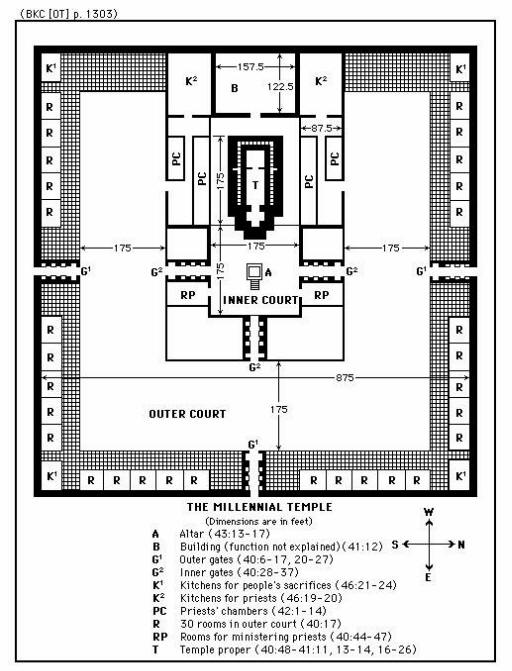
From 40v49 onwards we are taken to the temple itself in the middle of the temple complex. The measurements are significant numbers – multiples of 10 (symbolising many), multiples of 7 (symbolising perfection or completeness), 12 (symbolising Israel) and 3 (another number of completeness). The temple essential consists of the outer and inner sanctuaries. Taking Ezekiel with him, the man first measures the portico (porch), then the outer sanctuary, followed by the inner one – the most holy place, which was half the size of the outer sanctuary. The decreasing size of entrances towards the inner sanctuary stresses its holiness and exclusivity. We should only the man enters it, as it is forbidden for any human but the High Priest. The man must therefore be either a representation of God himself or an angel. Next he measured the temple wall and the thirty side rooms on each of three levels, along the north, south and west sides. These are probably store rooms for equipment, tithes and offerings. The rooms on each successive level get wider. And they could be accessed from the area around the temple, by staircases on the north and south sides. (You can see a plan of the temple here). Around the temple was a raised paved area, and then an open area stretching to the priests rooms to the north and south. To the west, there was a large building, perhaps also for storage. In terms of overall measurements, the length of the temple, of the yard and building to its west, and the breadth of that building and the inner court were all 100 cubits. Such detail seems strange to us, but it all symbolised the perfection of the temple itself. And the desire to describe and meditate on it should be likened to our desire to eagerly show pictures of a tour we had around Buckingham Palace. It should evoke wonder that God himself would actually return and live amongst his people. (All the above explains 40v48-49v14). (Compare its size with the temple of Solomon and the temple built later by Herod here).
           It seems the inner walls, porches and thresholds of the temple were covered with wood, much of which was covered with carved cherubim and palm trees – again alluding to Eden and stressing the presence of God (see Gen 3v24). The cherubim only had two (rather than four, chapter 1) faces, perhaps because of the demands of two dimensional art. They were of a man and a lion, the most noble of God’s creatures. In the outer sanctuary, in front of the doors leading into the most holy place, was a wooden altar-like table. This was called “the table that is before the LORD,” but was the table of presence from the original temple, on which twelve bread cakes were put ever Sabbath as a reminder that God’s was the people’s provider. Both sanctuaries had double doors, but only those of the outer sanctuary were carved with cherubim and palm trees (49v15-26).
            42v1-14 describes the priests’ rooms on the north and south of the inner court, opening onto the temple courtyard, facing north and south respectively. They are identical, being perfect rectangles (100x50 cubits) within a perfect square, again stressing symmetry. Each side included two sets of buildings. One consisting of changing rooms and rooms for eating and storing offerings. The other was a three story block. The dimensions are similar to those used elsewhere. And the focus stresses how sacred these places are because of their purpose and vicinity to the temple itself. This is supported by the fact that the priests must leave their garments before they go from the inner to outer court, because they are holy in having been so close to God. The sense is that they would otherwise spread holiness to the people, which could prove problematic if the people were not consecrated to God, as his wrath might then break out at their sin - as when Uzzah was struck down for coming into contact with the holy ark (see 2 Sam 6v7).
            Finally, the man takes Ezekiel outside via the east gate and measures the whole complex (42v15-19). It is surrounded by a wall in a perfect square of 500 cubit (850 feet) sides. 42v20 highlights the purpose of the wall. It is to separate the holy from the common. In other words, not only does this temple symbolise God’s presence with his people, but true and untainted worship being offered him, in which his regulations are kept, he is revered by bringing nothing unseemly close to him, and in which his dwelling place is not defiled by sin (contrast 22v26). We might consider the beauty of its design speaking of the final beauty of the church as the temple of the Holy Spirit, or the new creation that God’s glory will one day fill. Both are holy and set-apart, and in both, worship that is true, obedient, reverent and undefiled is to be offered.
                       
Praying it home:                                                    
Praise God for his beauty and majesty pictured in some way by the architectural beauty and majesty of this temple-palace. Pray that you would offer worship with your lips and life that is fitting to him.
                                                                                                    
Thinking further:
None today.


If you receive this post by email, visit bible2014.blogspot.co.uk and make a comment.

Friday, 28 November 2014

(333) November 29: Ezekiel 40 & 1 Peter 5

Ask God to open your mind, heart and will to understand, delight in and obey what you read.


To discover:­
As you read note how God’s holiness and inapproachability is stressed.

To ponder:
As usual a date is given (40v1). It could be significant. The 25 years is half the cycle to the Jubilee year, signifying renewal. The date and month recalls the Exodus (Ex 12v12), and the 14 (2x7) years may look to two complete periods until the setting up of the temple to be described. In a vision Ezekiel is taken to Jerusalem, which he views from a mountain. His note that the buildings looked like a city reminds us this is a vision, and that there is something different from the actual Jerusalem. We should not therefore presume what we read are instructions for a literal temple that must be built. Most likely, God is using the idea of the temple to portray truth about him coming to dwell with his people as he once did in the temple. This is rather like his using a detailed image of a new city of Jerusalem (with dimensions) in Revelation, to portray truth about the bride of Christ which is the people of God (Rev 21v1-21).
            Ezekiel first sees a man (as chapter 8) whose bronze-like appearance resonates with the creatures and God in chapter 1 (1v7, 27). He was standing at the entrance to the city with tools needed for measurement. He tells Ezekiel to listen and pay attention, as that is why he is there – and that he is to tell Israel everything (40v1-4).
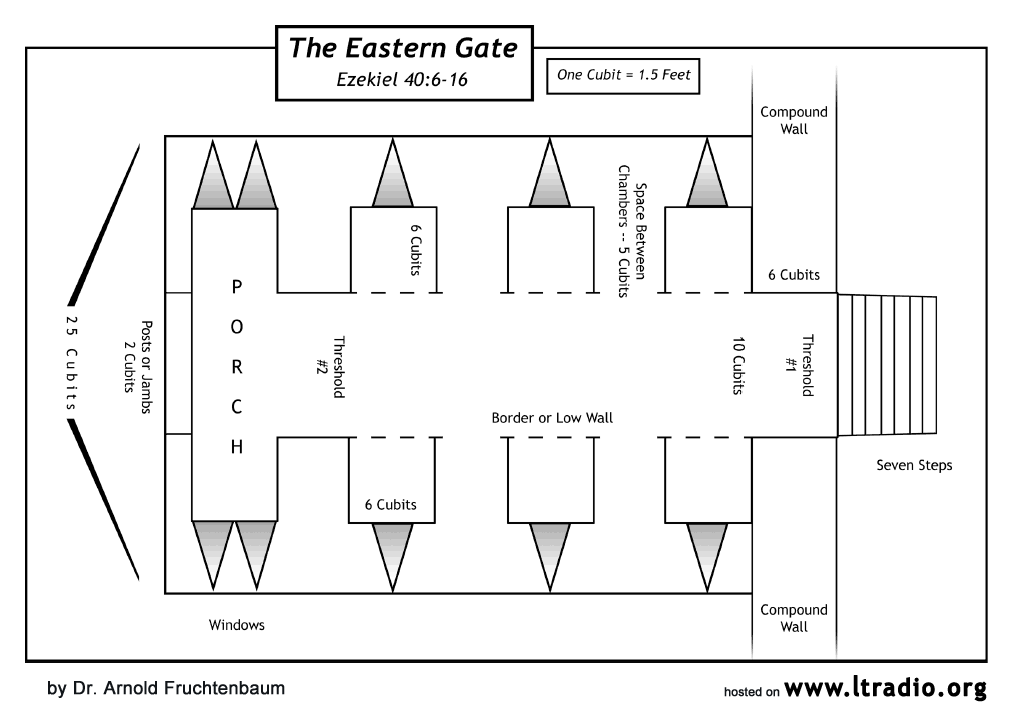
            Ezekiel then sees a wall enclosing the whole temple complex like a wall around a city. The man measures it as ten feet high and ten foot thick – perhaps suggesting it is impenetrable. He then goes to the gate facing east – the direction of sunrise and so salvation – measuring the threshold at 10 feet deep. This threshold leads into the gateway itself, which consists of a passage leading into the outer court (40v1-16, see diagram here). It has three square recesses on either side, which were probably for guards, implying the temple is secure and only those who should enter could enter. At the end of the passage was a roomy sort of porch, which led into the outer court. All in all, the gateway was 25 cubits (43 feet) wide and 50 (86 feet) long. This symmetry, which will find throughout the account, probably signifies the exact perfection of God’s plan for his people, and the utter holiness and order that accompanies his presence. The palm tree decoration implies the temple is like a mini-Eden and a picture of the new creation to come.
            The man led Ezekiel into the outer court, which had a pavement around its perimeter that was as wide as the gateways, stretching between them. (A diagram of the whole temple can be seen here). Thirty rooms were built into the wall around the outer court, opening onto this pavement. They were probably for worshippers or Levites who served in the temple. We’re told that there were identical gates on the north and south sides of the outer court too, all three gates having 7 steps leading up to them, the number of completeness and perfection. Across the outer court from each gate was a corresponding gate to the inner court. The distance across the outer court to the inner court was a hundred cubits (172 feet), the same distance as the length of the outer and inner gates combined. The inner gates were identical to the outer gates, except that they were a mirror image of them, with the porch being the first part you enter from the outer court. They also had 8 steps leading up to them, rather than 7 (40v17-36). The sense in all this detail is that you would ascend two stories, through two sets of guards, and with increasing difficulty, to where God was especially present. This stresses the increased degrees of holiness in coming closer to God, and so his inapproachability too.
            Because of this, a room was at the porch entrance of each inner gateway where burnt offerings were washed (40v37-43). There is then a description of twelve tables that seem to be in the porch of each gateway too, eight on which offerings were slaughtered, and four on which the implements used were kept. It may be some were also hung on the hooks on the wall. In seeing this portrayal of the temple as figurative of God’s future presence with his people that is ultimately fulfilled in Christ, we should note that this will involve no animal sacrifice as this has been superseded by Christ’s own sacrifice. Rather, we should understand this description as using concepts that would have been familiar to the Israelites, to make the point that sufficient means of atonement would be instituted to ensure God’s presence could remain with his people. The “twelve” tables in particular stress that what is instituted is sufficient for all Israel (the twelve tribes). We now understand that all this was achieved in the cross.
            Moving through the inner gate we come to the inner court, seeing two rooms adjacent to the north and south inner gates respectively (40v44-47). The former was for priests overseeing the general running of the temple that is in the centre of the complex, and perhaps guarding it too. The latter was for priests in charge of and perhaps guarding the altar. The note that these are only those qualified to draw that close to minister before God again stresses his holy purity. The inner court was measured as a hundred cubits square, corresponding with previous measurements. And it is noted that the altar was in front of the temple, as sacrifice was the only means one could approach the LORD.
           
Praying it home:                                                    
Praise God for achieving a way for us to approach him through Christ. Pray that you would better appreciate his holiness, and how necessary the cross was.
                                                                                                    
Thinking further:
None today.


If you receive this post by email, visit bible2014.blogspot.co.uk and make a comment.

Thursday, 27 November 2014

(332) November 28: Ezekiel 38-39 & 1 Peter 4

Ask God to open your mind, heart and will to understand, delight in and obey what you read.


To discover:­
As you read note why God is going to act as these chapters predict.

To ponder:
These chapters are notoriously difficult to understand, and we should note they come as the book becomes increasingly figurative in nearing its end. Ezekiel is to set his face against a king called “Gog” of “Magog” (literally, land of Gog), who also rules over Meshech and Tubal. Most likely these three lands refer to places far north of Judah, that were known for their barbarity (see Ps 120v5-7). Through Ezekiel God declares he is against Gog and will force him to do his will with hooks, like a captured beast or monster, bringing him and his army (described in a way that stresses its greatness) to invade Judah (38v1-9). The significance of his allies is probably that they are from the extremities of the known world from Judah’s perspective. And there are 7 of them (38v2, 5-6), implying completeness. The sense may therefore be of the whole world gathering against God’s people. This is supported by the names coming from the lines of Japheth and Ham, but not Shem, from whom Israel were descended (Gen 10v2-3, 6).
            The picture is of a vast hoard covering Israel as it advances on God’s people, with God stating that Gog will devise the evil scheme in order to plunder the richness of the land, which, in context, is a sign of God’s covenant blessing on his people. The onlooking merchant nations (38v13) are also a selection from the extremities of the world, and seem to represent those seeking an opportunity to gain materially from Gog’s attack. It is stressed that the land had recovered from its devastation by Babylon, and the people now lived in safety and without protection, no doubt because they trusted the LORD to be their refuge (38v9-16). The question, then, is whether Israel will be cast from the land again, or whether God’s promise that they would dwell there forever will be kept (see 37v25-28). So we are told that God is bringing this invader so that he may show himself holy to the nations – ie. show he is set-apart in being the only true and powerful God (see 37v23).
            37v17 records God telling Gog that his prophets had for years predicted him coming against Israel. As the timing of this is a future date, this stresses the importance of Israel referring back to Ezekiel’s own prophecy here. It may also suggest that the many prophecies predicting the Assyrian and Babylonian conquests from the north were paradigmatic for a final attack by the nations of the earth. And what God predicts is that in anger, there will an earthquake that will mark his presence and cause all creatures and peoples to tremble, and he will bring a sword against Gog in the form of causing his troops to kill one-another. He will also execute judgement on him and the troops of the nations with him, with plague, bloodshed, rain, hail and sulphur. These are pictures of judgement, but may be literal as sulphur was for Sodom and Gomorrah. The point is that God’s people don’t need to lift a finger, God fights for them, and by this means makes known to the nations that he is the LORD (37v18-23).
            Revelation 20v8-9 teaches this is fulfilled as the nations of the earth are gathered against God’s people by Satan, just before the final judgement. Some see this preceded by a millennium in which the people enjoy a secure and righteous life with Christ, fulfilling Ezekiel’s words in 37v15-28. The alternative would be to see Ezekiel’s description of life in the land as fulfilled in the church, as Christians anticipate the eternal state in their fellowship. Gog’s invasion would then imply a final great persecution of the church. However, we have seen hints that the account is figurative. So it could simply refer to God’s ultimate protection of his people from such threats whenever they come after the return from exile (as Rom 8v35-39). This would mean the events of chapter 38 don’t follow chronologically from those of chapter 37.
            God continues reiterating that he is against Gog, and will drag him against Israel only to defeat him, causing his army to be food for animals, and even sending fire against those who live safely in Magog and haven’t engaged in the battle. It’s probably a picture of his judging all. By this means he will cause his name no longer to be profaned, as Israel and the nations know come to know that it is holy – ie. that he is set-apart from all others (39v1-8). The picture of Israel using their enemy’s weapons as fuel for 7 years, stresses God’s supremacy in actually using the invasion for the good of his people, who are able to plunder the army (39v9-10).
            39v11-16 describes how Israel will carefully ensure all the slain are buried east of the Mediterranean sea in Israel, so that the land is cleansed. They will complete the work in 7 months, but then begin a search for any bodies that have been missed, ensuring they are buried too. The sheer amount of bodies is highlighted, as the mound will hinder travellers. But the focus seems to be on the fact that nothing of these people will remain in Israel. This is further stressed by the burial being preceded by scavenging animals feasting on the bodies as they lie on the ground (39v17-20, see 39v4). Ezekiel is to call them as the feast is portrayed as one God has provided, with the army being a sacrifice to him, like the fellowship offering the people would feast on as a sign that through the penalty for sin being paid they are at peace with God. This may be intended to stress the supreme fellowship the people will enjoy now the unbelieving world has been punished for its sin. However, the animals are invited to eat the fat and blood which was usually reserved for God (Lev 3v16-17). This emphasizes both how utterly destroyed the enemy are, and how degraded in this destruction – as will be the case with hell.
            We are told that the day God is glorified in this defeat of Gog, will be a memorial – so forever remembered (39v13). And by this means God will display his glory (his excellence) to the nations, and from then on Israel will know he is the LORD. This has been God’s intent throughout. When Israel went into exile, the nations assumed this was because their God had rejected them or was unable to protect them. But now he has displayed his faithfulness in defeating the greatest army, the nations will know that the exile could not have been for these reasons, but must have been because the people’s sin caused God to hide his face and hand them over to their enemies (39v21-24). So God declares he will bring the exiles back from their captivity, have compassion on them, and act in passionate concern for that his name is seen as holy. It is uncertain whether 39v26 refers to Israel forgetting or bearing their shame when in the land, but the latter has been stressed previously (36v31). Whatever the case, when they are in the land, God will show himself holy to the nations through what he has done in gathering them, and pouring out his Spirit so that they will follow his law and therefore receive his blessing (see 36v24-32). Then Israel will certainly know he is their God (39v25-29).
            Whatever our uncertainties, the key point throughout is that faithful Israelites, who after Christ are marked out by the fact they have become his followers, can be sure that God will never turn against them as his people (nor against Gentiles, who have joined them in following Christ). Their inheritance is therefore certain. They will never be ultimately overcome by the forces of evil. And when God judges the world and raises them to inhabit it, the world will see that their exile (and any subsequent trial Jews or now Christians might suffer) was not because of the unfaithfulness or inability of their God. The prophecy would therefore have caused the exiles to keep hoping in the LORD, as it would those who returned to the land, when oppressed by Persia, Greece and Rome. And it should cause us to do the same as we face oppression too.
           
Praying it home:                                                    
Praise God that he has defeated evil through the cross and so this final deliverance of his people is certain. Pray that those who are persecuted would be encouraged by it.
                                                                                                    
Thinking further:
None today.


If you receive this post by email, visit bible2014.blogspot.co.uk and make a comment.

Wednesday, 26 November 2014

(331) November 27: Ezekiel 36-37 & 1 Peter 3

Ask God to open your mind, heart and will to understand, delight in and obey what you read.


To discover:­
As you read note what God says about the future of his people.

To ponder:
These chapters are two of the most important in the book for understanding the New Testament. Ezekiel is now called to speak against the mountains, and so land of Israel. Just as Edom had coveted the land (35v10) so God says Israel’s enemies had, claiming the heights as their possession. But he responds that they hounded the people in order to take the land, and slandered it – by implying Israel’s exile from it resulted from impotence or rejection by their God (see 36v13-15 below). The LORD therefore declares to the various features of the land and the ruined towns that he has spoken against the nations, so they themselves will suffer scorn. This stems from his burning zeal which seems synonymous with his jealous wrath – implying that he is passionately outraged at the nations taking his own land to be theirs. He then promises that after acting against the nations, the land will be fruitful, as his people will soon return and he will multiply them (and their livestock) so the towns will be rebuilt, and the people not only settle as they had before, but be even more prosperous. Then the land will metaphorically know the one speaking through Ezekiel is the LORD – ie. he will have proved himself the living God (36v1-11), just as he will have when we find ourselves raised to enjoy this to the extreme within the new creation.
            God continues that the land will again be his people’s inheritance and it will never again deprive them of their children – no doubt a reference to it spitting them out because of their sin in fulfilment of God’s covenant promise (36v12, 17, see Lev 18v24-28). This theology of land in which its fruitfulness and security was a reflection of the power and nature of its god, pervades this section. So the people are portrayed as taunting the land for loosing its inhabitants to exile, and God declares it will no longer hear those taunts because he will ensure this doesn’t happen again (36v13-15). The LORD goes on to explain that the people were scattered because they defiled the land by their bloodshed and idolatry so that he judged them accordingly and poured his wrath on them. Yet wherever they then went, they profaned God’s name (ie. reputation) because of the assumptions about gods and land the nations had. They would have assumed that either God had proved unfaithful to people, or unable to defeat the gods of other nations so they could keep their land (36v16-21). The godless person who claims faith in Christ, should recognize the same seriousness accompanies their action. If they suffer judgement for it, as some do (see Acts 5, 1 Cor 11v27-34) this can profane God’s name as non-Christians might assume he has abandoned the person without reason or is incapable of keeping them from such trial.
            In response to all this, God stresses that what he is about to say he will do is not for his people’s sake, but for the sake of his name. Their actions have desecrated that name so that it is no-longer regarded as set-apart and so holy. He is therefore going to sanctify it, and show how set-apart in his purity and power he is, so that the nations will know that he is the LORD. He is going to do this by (1) returning the people to the land in a sort of second Exodus, (2) cleansing them from the guilt of sin that has defiled them – where the sprinkling with water picks up ideas of ritual washing and the sprinkling of the blood of sacrifices, (3) giving them new hearts that are no longer hardened to himself because his Spirit lives in them, moving them to obey his laws (36v22-27). It is this twofold work of dealing with guilt and then grip of sin, that lies behind Jesus’ teaching of new birth by water and the Spirit in which he draws a parallel with his work on the cross and his gift of life (Jn 3v5, 15). Although the people returned to the land in the fifth century BC, we therefore see a hint that Ezekiel’s prophecy would only be truly fulfilled in Christ.
            The point is that then God’s covenant relationship will be able to be maintained. The people will live in the land as his people and no longer be unclean. So they will experience the covenant promise of fruitfulness to the land being fulfilled, and no longer be disgraced in the eyes of the nations because of a famine that implies their God is unfaithful or impotent. Then, God says they will remember and loathe their prior practice. And, as if it ensure they don’t presume this future implies their actions have been anything less than disgraceful, he reminds them he is not bringing these things about for their sake (36v28-32). They are acts of pure grace.
            God adds that on the day of Israel’s cleansing, they will be resettled and become secure, the land will be cultivated until it is like Eden, and the nations will know the LORD has rebuilt what he destroyed. He states that this will be in response to a plea from Israelites, and implies they will then live in worship of him, as the cities will be filled with people like the flocks that are gathered as offerings during Israel’s feasts (36v33-38). We should not get too caught up in the chronology here. The point is that although the people did resettle in the fifth century, God’s act of cleansing his people and restoring the kingdom to a supreme state is one “day” (ie. period) of God’s action. Through Christ we know it spans his two comings. As he says to Nicodemus (Jn 3v3), it is only those who have been born again (fulfilling 36v25-27) who will see the kingdom (fulfilling 36v28-31).
            In chapter 37 God’s Spirit transports Ezekiel to a valley of bones. Their dryness shows they have been long dead. God asks if they can live to which Ezekiel affirms only God knows. Ezekiel is then told to prophesy to the bones, that God will make breath enter them and cause them to become enfleshed and alive. As Ezekiel prophesies, the bodies are re-constituted but not yet alive. He is then told to call breath to enter the slain so they live, and they come to life as a vast army. This is then explained: The bones represent dead Israelites (no doubt recalling those slain by Babylon) with a sense of this meaning that they are cut off from God’s promises (just made) of a glorious kingdom in the land. So God promises to open their graves, bring them to life by his Spirit, and settle them securely in the land (the inference of being an army), where they will know he is God (37v1-14). Verse 1 implies this is a vision. A metaphorical fulfilment in which this simply stresses there is still hope for the nation, or that looks to faithful Israelites coming spiritually alive in order to submit to Christ as king, is quite possible. However, the descriptions of life in the land (36v25, 37v22-28) these people will then enjoy, imply the final state, making a more literal fulfilment as faithful Israelites are raised from death more likely (see Jn 5v28-30). This would suggest that the full restoration of the kingdom Ezekiel has prophesied lies the others side of the resurrection (see chs 47-48).
            Ezekiel is then instructed to symbolise God uniting the northern and southern kingdoms in the land by the uniting of two sticks as one. He adds that they will be forever united under one Davidic king and shepherd, and having been cleansed, will no longer defile themselves as they had. The inference that they will be there forever with their children and children’s children under the same king, implies the eternal life of the resurrected state, and also that God’s intent for faith to be passed to each generation will have been fulfilled to some extent by this group. To them, he promises an everlasting covenant agreement, security, increase of numbers, his temple presence (see chs 40-46), and the relationship in which he is their God and they his people – and all so the nations know that God’s presence makes his people holy (ie. it sets them apart as an obedient people). This all looks to the great multitude inhabiting a new creation that is filled with the presence of God (Rev 21v22-27).

Praying it home:                                                    
Praise God for his readiness to raise and renew his people to inhabit the kingdom. Pray that you would faithfully teach this hope to the next generation.
                                                                                                    
Thinking further:
None today.


If you receive this post by email, visit bible2014.blogspot.co.uk and make a comment.

Tuesday, 25 November 2014

(330) November 26: Ezekiel 34-35 & 1 Peter 2

Ask God to open your mind, heart and will to understand, delight in and obey what you read.


To discover:­
As you read note what God promises to do for his people.

To ponder:
Ezekiel is now to prophesy against Israel’s religious leaders who should have cared for the people like shepherds for sheep. They are condemned for instead caring only for themselves, taking a milk product, wool and meat from the flock – which implies getting what they can from the people, whilst failing to actually give back by strengthening the weak, healing the sick or binding up the injured – a reference to practical care. Nor have they brought back those straying or lost (probably a reference to those who had turned from the LORD), but have ruled them harshly. And what this resulted in was the whole flock being scattered into exile, where they have been subject to attack from other nations (34v1-6). It is this imagery that Jesus used for the pastor, and here there is a rebuke for those who are greedy for gain and fail to actually minister to their flock.
            All this demonstrates that God’s sheep lack a true shepherd. So God says he is against the shepherds and will hold them accountable, removing them from their position so they can no longer feed themselves at the sheep’s expense, and so that the flock might be rescued from them (34v7-10). No doubt this was fulfilled in exile, but it looks to Jesus’ rejection of the leaders in his day.
            In what follows, God declares that instead he himself will do what the shepherds failed to do. He will search out his sheep, care for them, rescue them from the nations they are scattered to, and bring them back to their land as pasture. There he till tend them, and they will lie down and feed on the best grass. Moreover, God himself will bind up the injured and strengthen the weak (34v11-16). Yet he will also justly destroy the sleek and strong – because their good health has been at the expense of the others (see 34v3, 20). One cannot but think of Psalm 23 and John 10, where Jesus declares himself the “good shepherd,” and displays this in his healing miracles. It is in him that God shepherds his people, once more showing that the rescue from the oppression of exile was ultimately achieved when Jesus drew Jews to faith in himself, bringing them to the green pasture of the new creation. Yet he also shepherds them through his under-shepherds – the apostles and church ministers who fetch, feed and care for the flock with God’s word.
            The LORD adds that he will judge between sheep, and between rams and goats. Here he charges the shepherds with not only feeding and drinking the best of the pasture, but of ruining the rest so the other sheep don’t benefit. The picture is of how strong sheep bully the weaker ones, taking the best food and water (34v17-21). Jesus’ application to him judging on the basis of whether people display a true faith in caring for his people is therefore entirely apt and profoundly challenging. Not to, makes people liable to hell itself (Matt 25v31-47). And so through Ezekiel, God states he will judge between the fat and lean sheep, saving the weak so they are no longer plundered. And it is here he explicitly states he will place a Davidic descendent as shepherd over them, to tend them whilst he acts as their God. In the light of his prior promise to shepherd them himself, there are hints to this shepherd-king also being divine (34v22-24).
            In this context God promises a new covenant of peace, in which he rids the land of wild beasts so his people can live in safety, and be blessed with showers that will ensure good pasture. Here he moves from the illustration to simply state that the people will enjoy abundant harvests, and security in no longer being plundered. In being freed from their captivity to this, they will also know God is the LORD, and that he is with them as his people – the sheep of his pasture (34v25-31). This is a picture of the final judgement in which all who might oppress are excluded from the new creation so that God’s people can live not just in a world of abundance, but one of security. This should encourage us as we face evil in the present.
            Chapter 35 sees Ezekiel prophesying against Mount Seir – the geographical location of the Edomites. God declares he will stretch out his hand in judgement, making it a waste and causing its towns to be ruined, after which Edom will know he is the LORD. The reason is that, because of a long standing hostility to Israel, Edom somehow handed them over to Babylon – perhaps by joining the fight against them. God therefore swears by his own life that he will give them over to bloodshed (the punishment fitting the crime) and pursue them – no doubt a reference to an enemy chasing them. He adds that the slain will cover the land of Edom, stressing again that they will then know he is the LORD (35v1-9).
            What follows implies the reason for their betrayal of God’s people was a desire to posses their land – both north and south. God denounces this in particular because it expressed jealousy at Israel’s land, and anger at the Hebrew people despite the fact that God was with them – in the temple. He therefore says that as he judges Edom he will be making himself known to his people. Edom will then know the LORD heard all the things they said against Israel by claiming that in being laid to waste, the land was being given over to Edom to devour. God describes this as boasting against him, no doubt in presuming to be able to take the land he desired that Israel have. So he declares that because they rejoiced when Israel was desolate, they will be desolate when the whole earth rejoices (36v10-15). This may imply that Edom’s demise would occur when the rest of the world was celebrating the fall of Babylon. Once more, however, we see the punishment aptly fit the crime. We also see the seriousness of acting against God’s people.
            The reason for the prophesy against Edom being here is probably because of her particular sin with respect to the fall of Jerusalem which has just been noted, but also to display God’s commitment to remove the wild beasts who might otherwise devour his sheep when he gathers them from their exile (as 34v28).
                       
Praying it home:                                                    
Praise God for his care in coming to shepherd us himself in Christ. Pray for the raising up of faithful shepherds throughout the church.
                                                                                                    
Thinking further:
None today.


If you receive this post by email, visit bible2014.blogspot.co.uk and make a comment.

Monday, 24 November 2014

(329) November 25: Ezekiel 32-33 & 1 Peter 1

Ask God to open your mind, heart and will to understand, delight in and obey what you read.


To discover:­
As you read note what sins God condemns.

To ponder:
The lament of chapter 32 is given almost two years after the previous oracle. Pharoah is likened to a lion or sea monster. He causes danger and turmoil, but God will use many people to net him, haul him onto land where the birds and beasts will feast on him. The description of his remains covering mountains and valleys portrays the fall of Egypt as total, throughout its region. And the terror of the event is stressed by the language of darkness that is also a motif for God’s judgement. The event will cause many to be appalled for their own life, in seeing how susceptible to God’s justice they are too (32v1-11). God explains the attack will come from Babylon, which will humble Egypt’s pride, overthrow her hoards, destroy her cattle and strip the land. 32v14-15 implies that contrasting the thrashing of Pharoah in Egypt’s streams (32v2), after this Egypt will know the peace that stems from more stable rule, because they will acknowledge the LORD. This may look to the inclusion of Egyptians with Israelites through faith in the Christ. Whatever the case, the lament will be sung by the daughters of the nations on seeing what will happen (32v16). No matter how justified judgement is, we should lament the fall of peoples and nations.
            Two weeks later God’s word came again, telling Ezekiel to wail or mourn for the great multitude of Egypt, consigning her and the women lamenting her from the nations, to the pit of death. The point is that presumed greatness doesn’t mean favour from God. Rather, Egypt will lie with the other Gentile (uncircumcised) nations, whose leaders will acknowledge this from the grave. What follows is a list of the great nations who are there: Assyria, surrounded by her army who once spread such terror; Elam with those from her who were slain, bearing the shame of the terror they brought on others; Meschech and Tubal too, receiving punishment for their sins; Pharoah also; Edom, despite her power; and the princes of the north and Sidonians – slain in disgrace despite their power. The stress is on the fact that those who create terror in life will all die, with a hint that they will receive the just punishment for their sin. Indeed, they will lie with the uncircumcised, implying they are not privileged in the grave with the favour of God’s covenant people. God does not show favouritism. Those who abuse the much they now have, will have little then.
            As earlier in the book, the next oracle plays on the illustration of the watchman. Those who refuse to heed his warning trumpet are responsible for their own blood as they could have saved themselves. But if the watchman doesn’t sound the warning, although the man who suffers the sword will die for his own sin, God will hold the watchman accountable. God tells Ezekiel as his spiritual watchman, that the same principles apply to his role of dissuading Israel from their wicked ways when God gives a word that they will die. Indeed, if he seeks to warn, even if a man dies for refusing to repent, Ezekiel will be saved – presumably from being put to death because of bringing about the death of others through his negligence (33v1-9). It’s a sobering parable for the preacher.
            Here Ezekiel is to express the exiles’ sense of wasting away because of their sin. As they wonder how they will survive, God declares that as surely as he “lives” he takes no pleasuring the death of the wicked, but desires that they turn from sin and live. He therefore calls them to do so. His point is that their despair still displays an unwillingness to repent and trust God for life. The principles of justice are then outlined: Those who are righteous but who then disobey will not be saved from death, even if they were told they would live when righteous. Whereas the wicked who turns from that wickedness will be saved, even if told they will die when wicked. The sense is that one’s previous life will not be taken into account. One’s spiritual state when the accounting comes is what matters. Repentance is described as doing what is just and right, putting right what one has done wrong, following God’s decrees and doing no evil (33v10-16). To all this God anticipates the exiles saying this is unjust – perhaps because they felt God should not condemn those who were once righteous if they turn to sin, or forgive those who were wicked if they turn from it. If this is correct, they are wrongly assuming a scales of judgement in which the good must outweigh the bad. God simply states it is those who think this who are not just, whereas he judges according to people’s ways (33v17-20). But what we see is that this accounting accounts for one’s response to God – whether turning from him in complacency or to him in need.
            33v21-22 records how word finally came to the exiles of Jerusalem’s fall. God had prepared Ezekiel for this the previous evening, by giving him back his ability to speak freely (fulfilling 24v26-27, see also 3v26-27). God’s word comes first about those remaining in Judah. They were reassuring themselves that just as Abraham was given the land as a possession, surely they have been given it too. To this God asks “why,” when they break his food laws, commit idolatry, rely on violence and are immoral. Perhaps by sending a message, Ezekiel is to declare that the sword, wild animals and plague will kill those in the city’s ruins, the surrounding countryside, and stronghold towns or caves respectively. The phrase “as surely as the LORD lives” not only affirms its certainty, but the fact that it is because God lives this will happen, because it comes by his hand. The point is that none will escape his judgement. So he declares he will lay the land waste, humbling Judah’s pride, and the people will then know he is the LORD (33v23-29).
            God adds that Ezekiel’s countrymen in exile are saying to one-another throughout Babylon that they should go and hear God’s message. They therefore come and sit before him. But they do not practice what he says. As with false worship today, their mouths express devotion whilst their hearts are greedy for unjust gain. It’s a challenge to those who feign spirituality by talking the talk. Prophets used to prophesy to music. So these people’s spiritual blindness is seen in the fact that they see Ezekiel’s prophecies about God’s concern for his people as nothing more than love songs sung by an able musician. They are like those who esteem the rhetorical skill of a good preacher or the capabilities of a great worship band, but do nothing about putting what they hear from them into practice. But God declares that they will know Ezekiel is a prophet rather than a celebrity when his words come true.
           
Praying it home:                                                    
Praise God that in grace he judges us according to our current response not past deeds. Pray that you would put what you hear from preachers or worship songs into practice.
                                                                                                    
Thinking further:
None today.


If you receive this post by email, visit bible2014.blogspot.co.uk and make a comment.

Sunday, 23 November 2014

(328) November 24: Ezekiel 29-31 & James 5

Ask God to open your mind, heart and will to understand, delight in and obey what you read.


To discover:­
As you read note what provoked God in Egypt.

To ponder:
The next oracle is against Pharoah and Egypt. Pharoah is pictured as a sea monster claiming the Nile is his. As with the King of Tyre, his problem is one of arrogance. So God promises to pull him out with his fish (the people of Egypt) sticking to his sides, and leave him in the desert as food for beasts – so that the people of Egypt will know Israel’s God is the LORD (29v1-6). Although this aim has been stressed throughout the book, here we can note it was God’s great concern in the Exodus. Even in times of temporal judgement he seeks worshippers.
           Pharoah is pictured as a staff of reed. Israel sought to lean on him through their alliance, only to be injured as it splintered (29v6-7). It is because of this unfaithfulness as well as Pharoah’s arrogance, that God says he will bring the sword to kill both men and animals, causing Egypt to be desolate for forty years, with the people scattered throughout the nations. This time period is fitting when once considers the years Israel had to spend in the desert having escaped Egypt. At its end, God promises to bring the Egyptians back to their land from captivity to be a lowly kingdom that will never exalt itself again above nations. The point is that Egypt will no longer be a place Israel seeks to rely on, but a reminder of her sin in turning from God to seek Egypt’s help. And so they will know, as Ezekiel’s words are fulfilled, that God is the sovereign LORD (29v8-16). Only reliance on God is secure and safe. What follows is a word in which God explains to Ezekiel that because Nebuchadnezzar got no reward from Tyre for his hard campaign there, God will bring him against Egypt to carry of its wealth a reward (29v17-20). It’s another affirmation of Nebuchadnezzar as the LORD’s servant.   
            29v21 seems to say that one day (which can be a period) Egypt is humbled a horn (symbolising power) will sprout up for Israel. This is the language of he promised Davidic king as a flourishing branch. It is therefore intended to give Israel hope that with although the one they relied on will be humbled, God will give them sufficient strength through his own king. And then they will know that what he enables Ezekiel to say in their present, was from him as God. It is as Christ fulfils the prophets that we find our faith strengthened, and recognize God spoke through them.
            A lament follows that describes the destruction in and around Egypt. On a day of doom for the nations in general we are told anguish will hit Egypt, her people will be killed, wealth taken and foundations destroyed. The fall of her allies including God’s covenant people will accompany this, so that they know God is the LORD. On that day messengers will bring the news to Cush causing fear. God will do this through Nebuchadnezzar, and it is described as a drying up of the Nile. By this means he will therefore destroy Egypt’s idols and royal line, and the distress of the various regions of Egypt is then stressed. It ends once more with a note that this will be to put her pride – or proud strength – to an end, and so break the yoke she puts on others. The language of fire, storm, darkness and cloud echoes that of Sinai, stressing God’s awesome presence (30v1-19).
            30v20-26 ensures Judah doesn’t keep relying on Egypt. It speaks of how God had already severely limited Pharoah’s ability to fight (no doubt through Babylon), yet adds that he will metaphorically break his second arm so he cannot wield a sword at all. He will then scatter the Egyptians, contrasting his action on Pharoah with a promise to actually strengthen the arms of Nebuchadnezzar and put a sword in his hand, all so Egypt know God is the LORD. Sometimes the loss of something we rely on when we should rely on God, is in order to ensure we look to him.
            A little later God’s word came again. Perhaps with some sarcasm, Ezekiel is to ask of Pharoah and his army who can compare with their majesty. He is then to describe Assyria as like a cedar in Lebanon, tall, thick, and nourishing other trees (nations) too which it majestically towered over, with all the great nations living in its shade and so under its protection. The description of how abundantly it was watered showed how it was blessed by God. Indeed, he says he made it so beautiful that none of the cedars in Eden could rival it (31v1-9). Yet, God says that it is explicitly because it was so high and took pride in that, that God handed it over to “the ruler of the nations” (ie. Nebuchadnezzar) to cut it down. The picture of its branches falling in mountains, valleys and ravines probably stresses its geographical size, and how the whole empire fell. So all the nations lefts its shade. This meant leaving its protection, implied perhaps by the beast now being able to get at the birds in its branches (31v1-13). 31v14 implies that in the light of the fall of Assyria others trees (nations) by waters (ie. blessed by God) should take warning, recognizing they are never to so proudly tower high, considering themselves above other trees, as that would likewise mean death among mortal men – a reminder that kings of even the greatest nations are mere mortals. God adds that on the day Assyria was brought down, he restrained the waters (of blessing) in mourning, bringing gloom to Lebanon and causing the nations to whither in fear, as all the best trees of Lebanon (ie. nations of the world), its allies, were “consoled” at Assyria’s fall in the grave, being killed by the sword too. Bracketing the chapter with 31v2, 31v18 asks which of these trees can compare with Egypt in splendour, yet Egypt will be brought down to lie with the other uncircumcised too. It’s yet another reminder that the seemingly greatest kings and nations are subject to God for any greatness, and can be removed in a moment if arrogant. Here, we might remember that through all Ezekiel’s prophecies God speaks as the “Sovereign LORD.” They stress that he is the true and only ultimate ruler.
                                                         
Praying it home:                                                    
Praise God that he rules everything and all are subject to him. Pray that you therefore be kept from pride at what he has given you.
                                                                                                    
Thinking further:
None today.


If you receive this post by email, visit bible2014.blogspot.co.uk and make a comment.